Feeds:
Posts
Comments

Informal Logic Vol. 31, No.1

Informal Logic, vol. 31, no. 1

As part of the mission of RAIL is to keep readers informed of new publications, journals, and articles of interest, I’ve arranged with the editors to post announcements here when new issues of Informal Logic become available.  If you’d like to have your informal logic/argumentation-themed journal, or special issue similarly featured here by all means please drop me a line and let me know!

Click here or on the image above to reach the current issue of Informal Logic.  If you see something you find interesting or want to discuss in this issue, why not start the conversation by commenting on it below?

2011 BENJAMIN FRANKLIN TRANSATLANTIC FELLOWS (BFTF) SUMMER INSTITUTE
July 2-July 29, 2011 – Ages 16-18
Wake Forest University
Winston-Salem, NC
www.BFTF.org

Do you know a teenager (16-18) who is interested in meeting young people from Europe, Eastern Europe, and Eurasia? Do they have an interest in learning more about transatlantic relationships, public advocacy and civic engagement?

The Department of Communication at Wake Forest University is offering 10 Scholarships for American students to attend the 2011 Benjamin Franklin Transatlantic Fellows (BFTF) Summer Institute. These Scholarships include the following:

• $2,500 scholarship; Designation as Benjamin Franklin Transatlantic Fellow (covers tuition, activities, meals and lodging in WFU dorm, and partial travel funds to and from WFU)
• Participation in all Institute events, including classes on: Citizenship, Comparative Constitutionalism, Documentary Production and Theory, New Media, Public Advocacy, taught by Wake Forest and visiting faculty.
• Seven day educational trip to Washington, D.C. and Philadelphia, PA, including a visit to the State Department, The Washington Center and several sites including the Newseum in DC; Constitution Center in Philadelphia, etc.
• Civic engagement activities, local community service projects and workshops on public advocacy.
• Cultural activities including an International Dinner, visits to places of worship and other local sites.

The U.S. Fellows would join about 50 Fellows on the Wake Forest campus for a month-long Institute. The international Fellows are from over 30 countries ranging from Armenia to Iceland, Denmark to Kosovo, Malta to Lithuania. Participants will arrive at WFU on July 2 and depart on July 29, 2011.

Applicants must be U.S. Citizens and 16-18 years old. For more information and the application form, visit our website.

This lovely little RSA animation featuring linguist Sephen Pinker should be interesting for theorists of argument on multiple levels.  Such explanations as Pinker’s bear directly on how we take on enthymemes, how we think about dialectical guidelines, how we think about the practice of argumentation in general, etc.  I could go on, but instead I’ll let the charming video do the work*:

Direct Link: YouTube – RSA Animate – Language as a Window into Human Nature.

*Those who have heard me prattle on about David Lewis’s Convention in the recent past are hereby excused, but should watch anyway because of how cool these RSA animate thingies are. 🙂

Anna Elizabeth Dickinson (1842-1932), the first woman to address the US Congress was by all accounts "a gifted orator".

Many in the field of rhetoric, I’ll wager, are happy to see an article about their discipline at all in a major newspaper like the Guardian.  Being a philosopher myself I sympathize with the sort of small-town-ish “Hey! They’re talking about US!!” feeling engendered by articles like Mary Beard’s What makes a great speech?

The article itself, however, is rather a letdown in terms of what it communicates to the reader about rhetoric.

Let me begin in fairness by noting that Mary Beard is a well-known classicist in the UK.  Thus it is not surprising that her treatment of rhetoric here focuses primarily on sources and examples drawn from Greco-Roman antiquity.  Be this as it may, she speaks in a general voice here about rhetoric and so her discussion is disturbingly incomplete. Rather than showing rhetoric as the very active and modern discipline that it is, her focus on the ancients gives the impression that the study of rhetoric ended with Cicero. She makes no mention at all of any figures in the history of rhetoric between antiquity and the present day. Not even foundational figures of contemporary rhetoric like Perelman and Olbrechts-Tyteca, get a mention, to say nothing of figures lesser known outside rhetoric but equally if not more important within it like Burke, Richards, Toulmin, or Henry Johnstone Jr..  Though to her credit she avoids rehashing the standard Platonist objections to rhetoric, Beard’s presentation is rendered somewhat shallow by her lack of modern sources.  Continue Reading »

Theme: 1951 – 2011: 60 years of DEONTIC LOGIC

Special issue of Journal of Logic and Computation, corner on Deontic Logic and Normative Systems

Paper Submission Deadline: *September 1, 2011*

http://deonticlogic.org/

With his seminal paper “deontic logic” published in Mind in 1951, Von Wright launched the area of deontic logic. It is the field of logic that is concerned with obligation, permission, and related concepts.

We invite papers concerned with the logical study of normative reasoning, including formal systems of deontic logic, defeasible normative reasoning, the logic of action, and other related areas of logic, and the formal analysis of normative concepts and normative systems.
Continue Reading »

ESSLLII 2011

CALL FOR PARTICIPATION AT ESSLLI 2011

Meeting: 23rd European Summer School in Logic, Language and Information (ESSLLI)

Date: 01-Aug-2011 – 12-Aug-2011

Location: Ljubljana, Slovenia

Contact Email: esslli2011@gmail.com

Meeting URL: http://esslli2011.ijs.si/

Early registration deadline: 31-05-2011

********************************************************************************

*Meeting Description*

For the past 23 years, the European Summer School in Logic, Language and Information (ESSLLI) has been organized every year by the Association for Logic, Language and Information (FoLLI) in different sites around Europe. The main focus of ESSLLI is on the interface between linguistics, logic and computation.

ESSLLI offers foundational, introductory and advanced courses, as well as workshops, covering a wide variety of topics within the three areas of interest: Language and Computation, Language and Logic, and Logic and Computation. Previous summer schools have been highly successful, attracting up to 500 students from Europe and elsewhere. The school has developed into an important meeting place and forum for discussion for students and researchers interested in the interdisciplinary study of Logic, Language and Information. During two weeks, around 50 courses and 10 workshops are offered to the attendants, each of 1.5 hours per day during a five days week, with up to seven parallel sessions. ESSLLI also includes a student session (papers and posters by students only, 1.5 hour per day during the two weeks) and four evening lectures by senior scientists in the covered areas.

In 2011, ESSLLI will held in Ljubljana, Slovenia and will be organized by the Slovenian Language Technologies Society (SDJT), the Jožef Stefan Institute (IJS) and The Faculty of Mathematics and Physics (FMF) in Ljubljana, Slovenia. Chair of the Program Committee is Makoto Kanazawa (National Institute of Informatics, Japan), and Chair of the Organizing Committee is Darja Fišer (The University of Ljubljana, Slovenia). To contact the ESSLLI 2011 Organizing Committee, write to: esslli2011@gmail.com.

*Summer School Programme*

http://esslli2011.ijs.si/?page_id=897

*Online Registration Form*

https://www.kompas-online.net/Pages/MeetingsConferences/Register/RegisterV2.aspx?form=ESSLLI2011

Continue Reading »

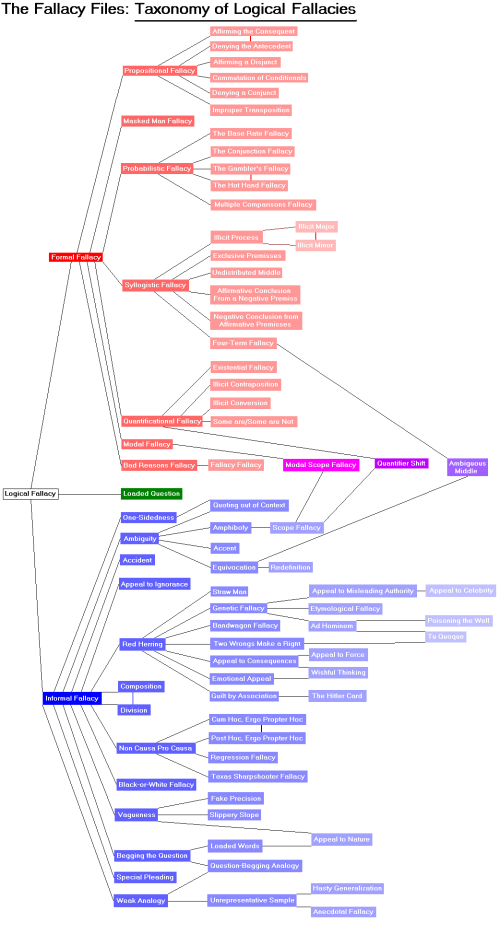
A Fallacies Concept Map

Here’s a lovely graphical representation of the family of fallacies via The Fallacy Files. (Note: I found out about this infographic first via the Philosorapters blog, which gives advice on job hunting mostly but also occasionally on teaching philosophy.) I think many readers of RAIL will find this way of cutting the cake rather interesting, as the classification of some fallacies is…let’s say novel.  Others represented here are altogether new to me (e.g. the “Texas Sharpshooter”).

Whatever one makes of it, you have to tip your cap to the work that no doubt went into putting this concept map together. I’d love to see some alternatives.  Anyone out there up for it?

I'm a sucker for a nice infographic!

Scottish Argumentation Day

Scottish Argumentation Day

The 2011 Scottish Argumentation Day will take place at the University of Aberdeen on the 4th of March in Room A31 of the Taylor Building (lunch will be provided). Scotland contains a number of world leading centres for argumentation research, and the purpose of the day is to bring together students, post-doctoral researchers and established scientists from these groups  to discuss their work, obtain feedback on it, and forge new collaborations.

The format of the day will depend on those attending. However, it is envisioned that participants will be invited to give brief presentations, followed by informal discussion sessions in the afternoon.

The event is free to all, and  anyone with an interest in argumentation is welcome to attend. If you are interested in coming along, or for further details, please contact Nir Oren (n.oren at abdn.ac.uk).

Dr. Nir Oren
Department of Computing Science
University of Aberdeen
AB24 3UE

http://www.csd.abdn.ac.uk/~niroren/

Cognition, Conduct & Communication CCC2011
06.10.11-08.10.11
University of Lódz, Poland

The Chair of Pragmatics at the University of Lódz, Poland is starting a new conference series: Cognition, Conduct & Communication. CCC2011 is the first international conference devoted to a complex yet integrated and consistent study of cognitive approaches to pragmatics and discourse analysis, language learning and use, and language disorders.

Conference focus

  • interdisciplinary yet synergical research in diversified cognitive and pragmatic phenomena and processes pertaining to communication in native and second/foreign language in normally developing as well as disordered individuals
  • cognitive, pragmatic and discourse analytic concepts at work across the contexts of first, second, foreign language acquisition, learning, processing, comprehension and production
  • pragmatic competence and pragmatic awareness development in naturalistic and educational settings, including the effectiveness of educational interventions undertaken to enhance pragmatic skills
  • individual learner/language user differences and pragmatic disorders

Conference discussions will proceed at the intersection of the following areas: cognitive pragmatics, societal pragmatics, clinical pragmatics, psycholinguistics, sociolinguistics, educational psychology, cognitive linguistics, cognitive psychology, applied linguistics, discourse analysis
Continue Reading »

Note: The submission deadlines have been updated.  Please click “continue reading” and scroll down to them to see the new deadlines.

CALL FOR PAPERS

TAFA 2011@IJCAI

First International Workshop on the Theory and Applications of Formal Argumentation (TAFA-2011)

Barcelona, Spain, 16 July 2011

http://www.csd.abdn.ac.uk/~niroren/TAFA-11/Welcome.html

About TAFA 2011
————————–

Recent years have witnessed a rapid growth of interest in formal models of argumentation and their application in diverse sub-fields and domains of application of AI. Argumentation thus shows great promise as a theoretically-grounded tool for a wide range of applications. This workshop aims at contributing to the realisation of this promise, by promoting and fostering uptake of argumentation as a viable AI paradigm with wide ranging application, and providing a forum for further development of ideas and the initiation of new and innovative collaborations. TAFA therefore encourages submission of papers on formal theoretical models of argumentation and application of such models in (sub-fields of) AI, and evaluation of models, both theoretical (in terms of formal properties) and practical (in concretely developed applications). We also particularly encourage work on theories and applications developed through inter-disciplinary collaborations.
Continue Reading »