International workshop
ARGUING ON THE WEB 2.0
Amsterdam, June 30 – July 1, 2014
Chairs: Fabio Paglieri & Chris Reed
Local organizer: Ulle Endriss
RATIONALE
Argument and debate form cornerstones of civilized society and of intellectual life. As online interaction usurps many traditional forms of interaction and communication, we would hope to see these processes alive and well on the web. But we do not. In spite of the ever-growing volume of online interaction, its current mechanisms hamper and discourage serious debate; they facilitate poor quality argument; and they allow fuzzy thinking to go unchecked. Meanwhile, these same online resources are increasingly being trusted and adopted with little critical reflection. The problem needs to be addressed from two different but converging perspectives: Continue Reading »
Posted in Argumentation, CFP, Computation, Connections | Tagged arguing on the internet, argumentation and technology, Chris Reed, Fabio Paglieri, online argumentation | 1 Comment »
Call for papers
TRUST, ARGUMENTATION AND TECHNOLOGY
Special issue of Argument & Computation
Guest edited by Fabio Paglieri (ISTC-CNR Roma)
Deadline for submission: 15 December 2013
RATIONALE
Trust and argumentation have both been explored extensively, for their own sake as well as in the context of their relevance for technological transformations. More recently, these topics have started to be studied together, with an eye to their numerous and deep interactions. Trust and argumentation converge independently from technology (e.g., trust in speakers often affect our assessment of their arguments), but recent ICT developments have greatly magnified their interplay. Continue Reading »
Posted in Argumentation, CFP, Computation, Connections | Tagged argument and computation, argumentation and technology, Fabio Paglieri, trust and technology | Leave a Comment »
CALL FOR PAPERS
Topoi: An International Review of Philosophy
VIRTUES AND ARGUMENTS
Deadline for submission: September 1, 2014
GUEST EDITORS
Andrew Aberdein (Florida Institute of Technology)
Daniel Cohen (Colby College)
OVERVIEW
Virtue-based approaches have made substantial contributions to ethics and epistemology. They have also found application in more unexpected fields, including the study of argument. Virtue Argumentation Theory mandates a shift in focus from acts and objects, or processes and products, to agents. Thus, Virtue Argumentation Theory brings a set of difficult but important new questions into focus, particularly about arguers’ conduct in inter-agent transactions. At the same time, Virtue Argumentation Theory also provides new signposts leading to their resolution. Several authors have recently begun to suggest answers to these questions. This special issue will consolidate and extend their work.
POSSIBLE TOPICS Continue Reading »
Posted in Argumentation, CFP, Communication | Tagged Andrew Aberdein, argument and cognitive science, biases and heuristics, Dan Cohen, Topoi special issues, virtues and arguments | 1 Comment »
CALL FOR ABSTRACTS
26th Anniversary Annual Meeting
May 3-4, 2014
New York City, NY
Theme: Clinical Reasoning
Conference Co-Chairs:
Ben Lewis, MD University of Utah School of Medicine
Brent Kious, MD PhD University of Utah School of Medicine
Claire Pouncey, MD PhD University of Pennsylvania
John Z Sadler, M.D. UT Southwestern Medical Center
Philosophers and clinicians have good reasons to reflect upon the processes of clinical reasoning. It is perhaps among the most important of the under-theorized and under-discussed elements of mental health practice. Despite being a psychological process that clinicians engage with every day, clinical reasoning remains poorly characterized both methodologically and pedagogically. Furthermore, it remains unclear how to combine the experiential aspects of clinical practice, with its traditional maxims and heuristics, with more evidence-based approaches. Models of psychiatric practice commonly overlook clinical reasoning processes and problems.
For this 26th annual meeting of AAPP, our theme focuses on the conceptual and philosophical aspects of clinical reasoning. Continue Reading »
Posted in CFP, Connections | Tagged AAPP, clinical reasoning, philosophy and psychiatry, reasoning in psychiatry | 1 Comment »
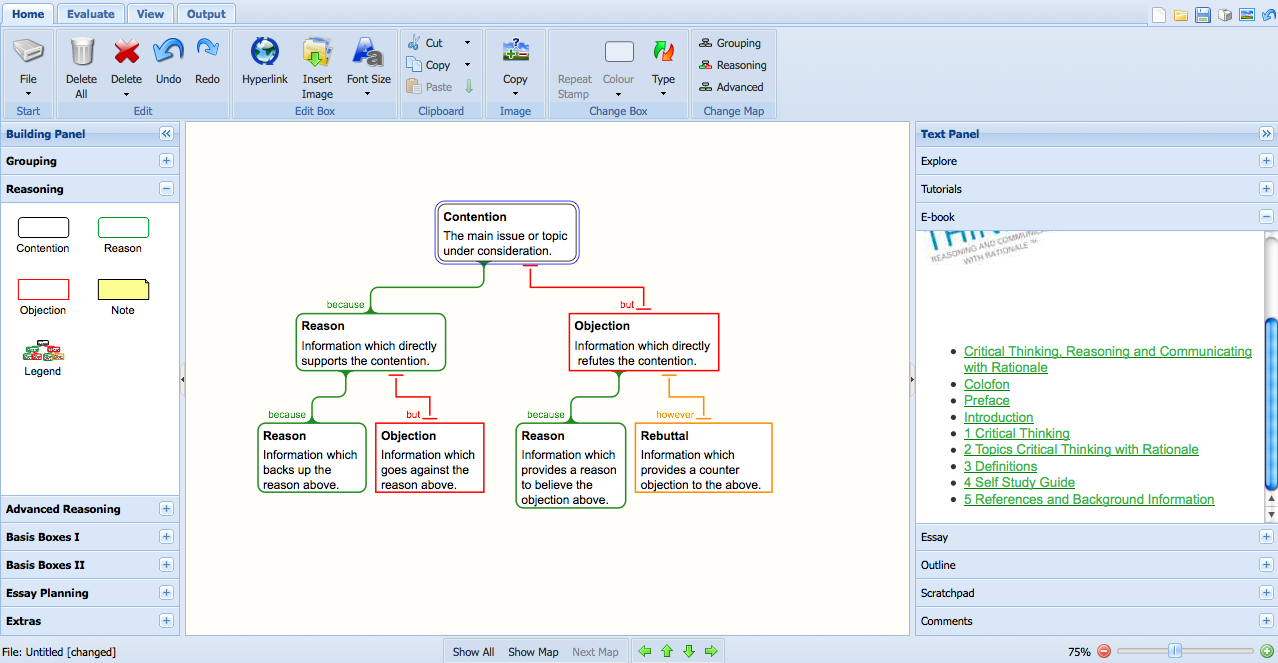
A screen shot of Rationale Online, click for a larger view.
It’s no secret to regular readers here that I’m a big fan of argument mapping. I’ve written about it several times and it’s come to be a very important component of my teaching. That’s why I’m happy to have added Rationale Online, a web-based version of the Rationale software package, to the RAIL Resources page. Beyond merely listing it there, though, I thought I’d put up a short post about it as I think it really does represent a positive step in the evolution of argument diagramming software for the classroom.
The diagramming system used in Rationale Online is a descendant of that pioneered by Tim van Gelder (some will remember Reason!Able), wherein one can diagram both arguments and various sorts of rebuttals, with or without incorporating various sorts of argument schemes from a number of different models. Continue Reading »
Posted in Computation, Connections, Critical Thinking, Discussion, Teaching | Tagged argument mapping, Kritisch Denken, Rationale Online | Leave a Comment »
April 11-13, 2014
Wake Forest University
Winston-Salem, North Carolina
The 15th Biennial Wake Forest University Argumentation Conference will feature keynote addresses by Hans Hansen, Ekaterina Haskins, and Catherine Palczewski, as well as a special workshop with Frans van Eemeren and a workshop for undergraduate students with Gordon Mitchell.
The Biennial Wake Forest Argumentation Conference began in November, 1983, with a one-day conference on the Wake Forest University campus. After again meeting on the Wake Forest campus in 1985, the Conference was convened in 1987 in the Wake Forest study abroad facility, Casa Artom, in Venice, Italy, with co-sponsorship from the International Society for the Study of Argumentation (ISSA). The conference has subsequently alternated between “the Venice Conference” and domestic sites.
The 15th Wake Forest University Argumentation Conference will take place concurrent with the 2014 Wake Debate Reunion in Winston-Salem, North Carolina.
We invite papers, panel and seminar submissions: Continue Reading »
Posted in Argumentation, CFP, Connections, Pragma-dialectics, Rhetoric | Tagged argumentation conferences, Wake Forest University | Leave a Comment »
Along with a team of fellow researchers, Vittorio Girotto (University of Venice) is investigating the intuitions people have about the outcomes of group reasoning efforts. Part of his research involves the survey that can be found at this link:
https://sasupenn.qualtrics.com/SE/?SID=SV_0xLZ2rduJdZ3OFn
The survey takes only a few minutes to complete and should be interesting for respondents with experience in argumentation theory, informal logic, or critical thinking. The research team would be most grateful for responses!
Posted in Connections, Research Projects | Tagged emprical argumentation research, group reasoning outcomes, Vittorio Girotto | Leave a Comment »
The eColloq on Argumentation is a running, online conference on any and all topics related to argumentation theory. The 8th eColloq on Argumentation will be held on 30 October 2013. The list of presenters and discussants is now being put together. Those interested in giving a paper or in joining as discussants are encouraged to visit the eColloq Website.
Posted in Announcements | Tagged eColloq, Frank Zenker, online argumentation conferences | Leave a Comment »

As if a new issue of Cogency wasn’t enough to keep us all engrossed in our reading, there is a new issue of Informal Logic out as well. Hilde van Belle’s, “Less Ado, More Done: Verbal and Visual Antithesis in the Media” offers an excellent a contributions both to the worthy effort to explain the idea of antithesis in Aristotle’s rhetorical framework (per Fahnestock) and to the ongoing discussion about multi-modal arguments. It is well worth the time of anyone interested in either discussion. Though quite a different paper, “The Dialogical Force of Implicit Premises: Presumptions in Enthymemes”, by Fabrizio Macagno and Giovanni Damele is also a very thorough and fascinating treatment of its topic. Haven’t gotten to the other papers yet, but these two suggest a very strong issue of IL indeed.
Posted in Announcements | Tagged enthymemes, Fabrizio Macagno, Giovanni Damele, Hilde van Belle, Informal Logic journal, multi-modal arguments | Leave a Comment »

As of a few weeks ago the latest issue of Cogency has been released. The issue contains a number of interesting articles, many of which bear thematic connections to the last OSSA conference back in May. Of these I recommend two in particular: Dan Cohen’s “Skepticism and Argumentative Virtues“, and Harvey Siegel’s “Argumentation and the Epistemology of Disagreement”. Those that had the good fortune to be at Harvey Siegel’s talk at OSSA on the topic of the latter article will remember an interesting and insightful discussion that brought together recent literature in epistemology and the corpus within argumentation theory on Fogelin’s theory of deep disagreement. Compressed as it was, the presentation hit every major point in the discussion so well that I wound up abandoning a project on the same topic. (To paraphrase Kenny Rogers, you gotta know when to fold ’em!) Dan Cohen’s paper in this issue of Cogency brings East Asian philosophy to bear on the themes of his keynote address at OSSA 10. Whether you happened to agree with his remarks there or in this article or not, I’m confident in saying that I think you’ll find it harder to find a more interesting paper before year’s end.
Posted in Announcements | Tagged argumentative virtues, Cogency journal, Dan Cohen, Deep Disagreement, epistemology of peer disagreement, Harvey Siegel, OSSA 10 | 1 Comment »
« Newer Posts - Older Posts »

 RAIL
RAIL 