Feeds:
Posts
Comments

Archive for the ‘Connections’ Category

Recently I happened upon Big Questions Online, a blog about exactly what it’s name suggests.  There are a few features that mark the blog out as unique. One is it’s sponsor (the Templeton Foundation). Another is the practice they follow of open but moderated conversation about each post. (Think American Dialectic, but less formal.) It’s a good format for argumentation theorists who are interested in studying online exchanges.  The posts are interesting and well-written enough to make them good discussion starters for classes too.

Read Full Post »

The Evolution of Argumentation: The Sperber-Mercier Theory

5-6 October 2012

University of Windsor, Windsor, ON, Canada

Keynote Speaker: HUGO MERCIER, University of Neuchâtel

Panelists:

  • Dr. Mark Aakhus, Communications, Rutgers University
  • Dr. Lori Buchanan, Psychology, University of Windsor
  • Dr. Ian Hacking, Philosophy, University Professor Emeritus, University of Toronto; Permanent Chair in the History and Philosophy of Scientific Concepts, Collège de France.
  • Dr. Burkhard Schafer, Computational Legal Theory, School of Law, University of Edinburgh

Chairs:

  • Dr. Douglas Walton, CRRAR & Assumption Chair in Argumentation Studies, University of Windsor
  • Dr. Steve Patterson, Philosophy, Marygrove College, Detroit.

Sponsored by:
THE CENTRE FOR RESEARCH IN REASONING, ARGUMENTATION, AND RHETORIC (CRRAR)

For more information contact: crrar@uwindsor.ca

Read Full Post »

From the Mellon/ALCS Fellowship homepage:

ACLS invites applications for the seventh annual competition for the Mellon/ACLS Dissertation Completion Fellowships, which support a year of research and writing to help advanced graduate students in the humanities and related social sciences in the last year of Ph.D. dissertation writing. The program encourages timely completion of the Ph.D. Applicants must be prepared to complete their dissertations within the period of their fellowship tenure and no later than August 31, 2014. A grant from The Andrew W. Mellon Foundation supports this program.

The deadline is October 24 for fellowships lasting one year, from Summer 2013 to Summer 2014. Political philosophers and others who work in political theory are particularly encouraged to apply.

Read Full Post »

Call for Papers: JURIX 2012

http://conference.jurix.nl/2012/cfp.html

The 25th International Conference on Legal Knowledge and Information Systems
University of Amsterdam, The Netherlands, 17-19th December 2012

Celebrating 25 years of supporting and enhancing cutting edge research in the interface between law and computer technology, the 2012 JURIX  conference will return to its roots in Amsterdam. We invite submission of original papers on the advanced management of legal information and knowledge, covering foundations, methods, tools, systems and applications for the following (non-exhaustive) list of topics: (more…)

Read Full Post »

RAIL is pleased to recommend the Special Issue of Studies in Logic, Grammar and Rhetoric on Argument and Computation.
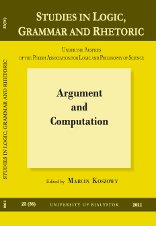
If, for some reason, you’re not yet paying attention to the things that are happening in the computation-based wing of argumentation theory, let me ever-so-humbly suggest that you should be. The excellent work being done in this area integrates not only key insights from mainstream contemporary argumentation theory but key insights from the ever-developing field of non-monotonic logic too.  Well and truly gone are the days when, as applied to logic, ‘formal’ meant ‘classical’.  This is truly exciting stuff.  Those with no background in the overlap between argumentation and computation may wish to begin with Chris Reed and Marcin Kosowy’s excellent introduction.  Following that, I would recommend Doug Walton’s article, “How to Refute an Argument in Artificial Intelligence” and Marcin Lewinsky’s article too as being particularly friendly to those whose background is heavier in argumentation and/or dialectics (per the Walton-Krabbe model) than in computation as next steps.

This issue is special in that it shows the relevance of computational approaches to nearly every branch of argumentation theory. To look at what some would consider extremes, for example, formal logic is represented in Kazimierz Trzęsicki’s excellent treatment of the problem of argument classification, but so is rhetoric in the article by Katarzyna Budzyńska and Magdalena Kacprzak, that represents the latest extension of their work at the time of this writing.

It is timely too. For those who have an interest in the way that argumentation is carried out through the medium of the internet this issue will be very useful indeed. The aforementioned article by Lewinsky covers this ground as does the article by Karolina Stefanowicz.  Those interested in contemporary pragma-dialetctics will also find much to pique their interest here, especially the article by the team of Jacky Visser, Floris Bex, Chris Reed and Bart Garssen.

Though of course the computational wing of argumentation theory is established and thriving in departments all over the world, I think this issue of Studies in Logic, Grammar and Rhetoric also shows the variety of good things that are happening in what is becoming the vibrant argumentation theory community of Warsaw. We should all be paying attention.

Read Full Post »

  SECOND CALL FOR PAPERS                

for the 7th International and ECAI 2012 Workshop on

EXPLANATION-AWARE COMPUTING (ExaCt 2012)

One-Day Workshop, 27 or 28 August 2012, Montpellier, France
http://exact2012.workshop.hm

** Submission deadline: May 28, 2012 **

When knowledge-based systems are partners in interactive socio-
technical processes, with incomplete and changing problem descriptions,
effective communication between human and software system is vital.
Explanations exchanged between human agents and software agents may
play a key role in such mixed-initiative problem solving. For
example, explanations may increase the confidence of the user in
specific results or in the system as a whole, by providing evidence of
how the results were derived. AI research has also focused on
how computer systems can themselves use explanations, for example to
guide learning. (more…)

Read Full Post »

Below are a few details about an intensive graduate course on reasoning to be held over one week at Lund University in Sweden.  Credits earned will be transferable, and there is a possibility that help with accommodations may be made available.

LUND UNIVERSITY
Reasoning
, 7,5 ECTS
Lecturer: Frank Zenker
Course dates: One week (Mo-Fr 10-12 and 14-16) in autumn 2012. Enter your date preferences now:
http://www.doodle.com/8r8b6vaxbaqnt7iq
If you would like to take this course please get in touch with the instructor now. E-mail & webpage

Course description
The study of reasoning—deductive, inductive, abductive, belief revision, defeasible, cross cultural, conversational, argumentative—is a major focus of investigation in both psychology and philosophy. Next to more traditional issues arising from the rationality debate, this includes a focus on fallacious reasoning and its reduction through education, the development of pragmatics, and the study of human reasoning process through neuro-imaging techniques.

Aim: The aim of this course is to enable learners to orient themselves in this research area (which may reasonably be called interdisciplinary) to the extent that they can actively participate in current empirical research and discourse on this matter.
We will work through select parts of a recently compiled selection of “classics” from a reader by Adler and Rips (2008). The three major themes are: 1. Foundations of Reasoning (Philosophical Viewpoints; Fallacies and Rationality), 2. Modes of Reasoning (Deductive Reasoning; Induction; Dual and Integrative Approaches; Abduction and Belief change; Causal and Counterfactual Reasoning; Argumentation); 3. Interactions of Reasoning in Human Thought (Reasoning and Pragmatics; domain-specific, Goal Based, and Evolutionary Approaches; Reasoning and Cultures; Biology, Emotions, and Reasoning).

Workload/Grading: Successful completion requires reading 20 to 30 pages per meeting, and the preparation and delivery of a max. 30 minute group presentation on one of the above subthemes (the presentation requires additional reading of ca. 60-90 pages). Learners are expected to focus on at least one of the above subthemes (see the table of content under the link below).
Grading occurs on the basis of presentation, an intermediate quiz, peer feedback, and a final paper (of 10-15 pages) due within 2 months after the end of the course.

Prerequisites: A background in mathematics or logic may be found helpful for some (but not all) subthemes. Learners with a background in the empirical sciences are especially welcome. A background in philosophy is not necessary to successfully conclude the course. Those interested in pursuing empirical work are assumed to have a background in empirical research methodology (which is not provided in this course). The course is open to students at Master’s level and up. The language of instruction is English.

Reference
Adler, J.E., and Rips, L.J. (2008). Reasoning. Studies of Human Inference and its Foundations. Cambridge: Cambridge University Press (will be made available).
http://www.amazon.com/Reasoning-Studies-Human-Inference-Foundations/dp/0521848156

For more information contact Frank Zenker, Department of Philosophy & Cognitive Science, Kungshuset, Lundagård, 222 22 Lund, Sweden, Tel. 0046.70.148 31 35, http://www.fil.lu.se/persons/person.asp?filpers=792.

Read Full Post »

My but these things are popular. This one comes to us via yourlogicalfallacyis.com and is free to download in three sizes. The graphic is also downloadable as vector art for those saavy and motivated enough to want to work with the image some more. In terms of design I think I like this one the best of all those shared on RAIL so far. (You can see the others here and here.) It also avoids the tricky business of classification and therefore might be more useful for teaching purposes. Below is a (crummy) screenshot. The files available for download are much higher quality.

Who are those three chaps in the middle there?

It is interesting that the fallacies seem to be bubbling up as a meme in the culture at large like this. I wonder if it’s a sign of sorts that people have had enough of the shoddy, transparently shortsighted and self-interested discourse that has come to characterize so much of public life and are starting to crave discourse of a different kind–perhaps more rational, thoughtful, and careful.  That would be nice…and timely too.

Read Full Post »

Here’s a short documentary on appeal to expert authority, produced by the CBC.  I found it by way of Ben Goldacre’s secondary blog. If you don’t know about Goldacre or his work on calling out abusive and phony experts in the UK, you should. His blog Bad Science is highly recommended reading.

The documentary:

Read Full Post »

The ever-industrious folks at ARG:Dundee (the group behind the popular argument diagramming software Araucaria) have a lovely new tool for keeping track of and participating in argumentation on the “blogosphere”.  They call it “argublogging“. I think it’s an impressive extension of the work they’ve done on the Argument Interchcange Format, or AIF. The video below gives a demonstration of how ArguBlogging works.  If you use argument diagrams in class and discuss the kinds of current events that get discussed on blogs then this program may well be your new best friend. Have a look. Try it out.  Send them feedback.  This is work worth supporting.

Read Full Post »

« Newer Posts - Older Posts »