Feeds:
Posts
Comments

Well, you've got to admit that it's easy to work with from a theoretical perspective...

Creating explanatory or theoretical models of complicated phenomena is one of the chief intellectual activities of academics in nearly every field.  As we do this, it is salutary to remember that as powerful and helpful as our models can be they can also bewitch us too.  Rather than providing us with a lens that helps us see the phenomena we study more clearly, they can inflict a kind of selective vision on us that shackles us to our grounding assumptions, forces interpretation in their terms and blinds us to important bits of information that lie outside their boundaries.

Sometimes, this can be funny.  For example, I recall a bit of apocrypha about a philosopher who, upon first encountering black swans, rather than admit them as proof of that the conclusions of inductive arguments were underdetermined by their premises insisted instead that those black feathery things serenely gliding around on the water out there couldn’t possibly be swans at all.

Physicists are susceptible to this sort of thing too and they recognize it in this old and much beloved self-effacing joke.  It is funny, but I can’t help but think as well that lurking somewhere in there is a new fallacy patiently awaiting discovery by some intrepid researcher in argumentation theory.  Certainly being in the grips of a model is a common enough cause of poor argumentation to warrant designation as a fallacy of some kind.  I’m willing to start the process if you are.  Post a short description of your candidate for the new fallacy here in the comments section.  Best entry wins…er…let’s say eternal glory. 🙂

Kairos currently presents three annual awards:

These awards are presented each year at the Computers and Writing Conference (winners need not be present although they are certainly encouraged to attend).

Please click on any of the award names for criteria and submission guidelines. Kairos also announces the calls for award nominations on various electronic mailing lists and on Kairosnews.

We also invite you to browse the list of past award winners to experience the variety of webtexts and weblogs which have qualified in the past.

The deadline for nominations for all awards is FEBRUARY 20, 2011.

NCA 2011: “Voice”

The American Forensic Association (AFA) invites submission of competitive papers, panels, and public debate events related to all types of forensics, oratory, and argumentation in both competitive and public contexts.

The 2011 NCA convention theme “Voice” invites scholars to reflect on how argumentation and forensic practices intersect across the conference theme. Papers, panels and programs submitted to the division may be theoretical, empirical, and/or critical in nature, and the division encourages a variety of methodological approaches.

Papers should be typed, double-spaced, less than 6,000 words, and written to conceal authorship and institutional affiliation. A title page should indicate author(s), affiliations, addresses, e-mails, phone numbers, and word count. Papers should be accompanied by an abstract no longer than 150 words. Panel proposals should include a rationale for the program, abstracts of papers to be featured, and the addresses and telephone numbers of the participants.

Panel proposals referencing/reinforcing the convention theme are highly encouraged. Panels are encouraged to include authors with diverse institutional affiliations, and to include the name  of a Chair and a Respondent who are not one of the presenters. Panel proposals must include a 150-word description of the content and format of the panel, and a brief abstract of each paper or presentation. All submissions will be blind reviewed. One or more panels will be composed  of competitively selected papers if submissions warrant.

All proposals (including competitive papers)  must be submitted online at http://www.natcom.org/ via the All Academic website.

The submission period runs from January 10 to March 16, 2011.

The AFA point of contact for submissions is Scott Harris, Department of Communication Studies:

102 Bailey Hall
1440 Jayhawk Blvd,
Lawrence, KS 66045

sharris@ku.edu


Rights and Responsibilities:
A Symposium on Citizenship
Wake Forest University
Thursday, April 7, 2011

CALL FOR PAPERS, PANELS, AND OTHER CONTRIBUTIONS
DEADLINE: March 10, 2011
Participants will be notified by March 21

The Department of Communication, the Institute for Public Engagement and
the Office of the Provost at Wake Forest University invite students,
scholars, community members, interest groups, and businesses to a
Symposium to discuss the rights and responsibilities of citizenship.

We welcome all contributions addressing themes related to citizenship
(papers, proposals for panels, and other creative ideas). Issues may
include, but are not limited to:
• Voter participation and involvement
• Role of non-profit organizations
• Conceptions of state security and privacy rights
• Investing in local communities
• Rights of others
• Religion and citizenship
• Influence of social media, new media
• Policies on citizenship, rights and responsibilities

Papers must not exceed 25 pages and include a separate cover page with
complete contact information. No information identifying the author
should appear on the paper.

Panel Discussion/Debate/Roundtable Proposals must include a 250-word
abstract, a 250-word rationale, and a list of participants, their
affiliation and contact information.

Two $300 prizes will be awarded for Best Student Paper and for Best
Panel. A small scholarship for travel and lodging expenses is available.
If you wish to be considered for the scholarship, please include a short
letter with your application.

Send or e-mail all materials to:
Alessandra Beasley Von Burg
Department of Communication
Wake Forest University
Box 7347, Reynolda Station
Winston-Salem, NC 27109
beaslea@wfu.edu

CFP: ExaCt 2011

Call for Papers: 2011 Workshop on Explanation Aware Computing

Click on the flyer below for more info, including workshop themes and submission deadlines.

CFP Flyer

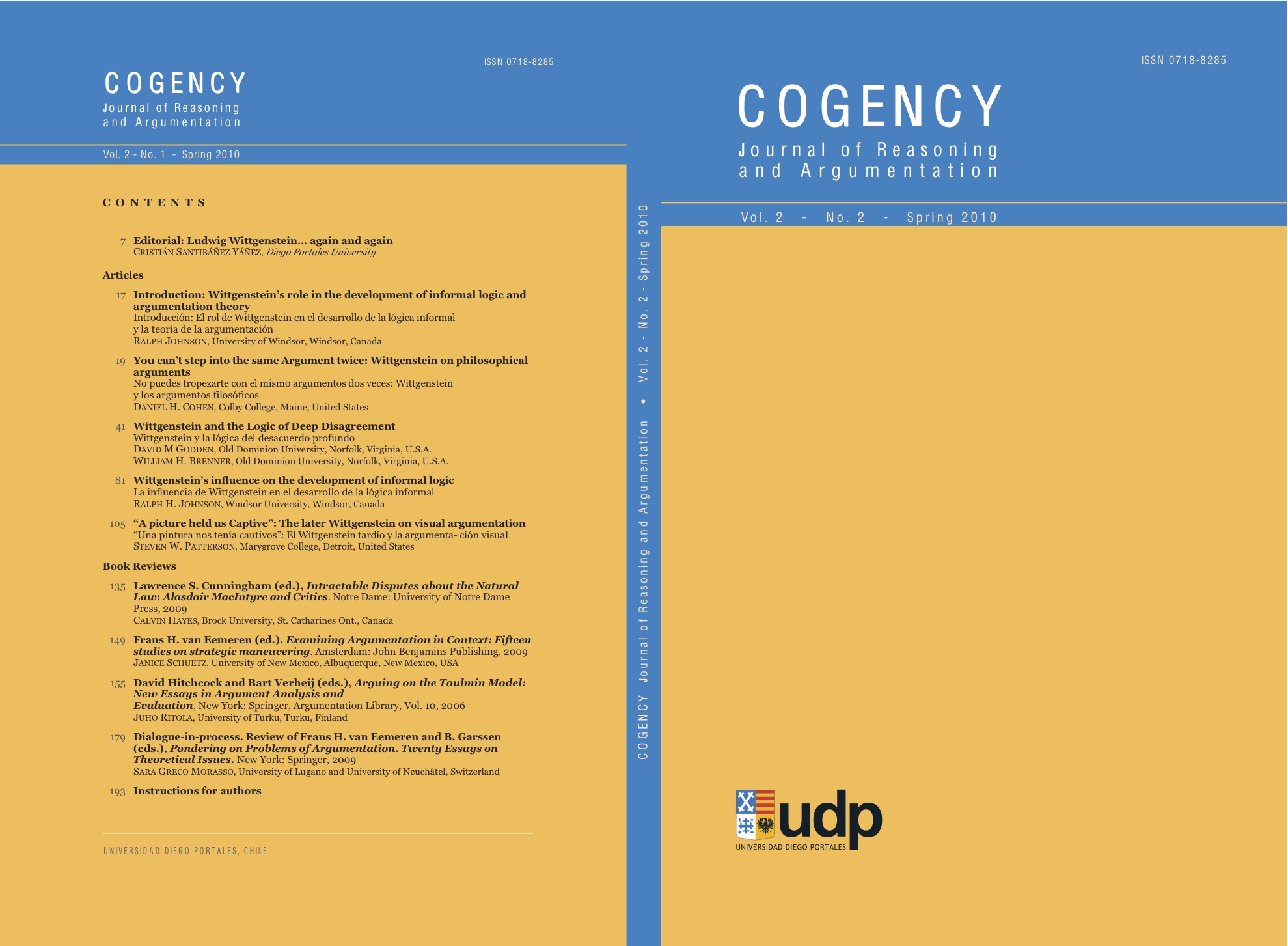
Cogency Vol. 2 No. 2: Special Issue on Wittgenstein and Argumentation


The latest issue of the journal Cogency focuses on the relationship between the philosophy of Ludwig Wittgenstein and argumentation theory.  Having had the good fortune to write one of the articles myself and thereby to have an early look at the contents, I feel confident in saying that it’s a pretty interesting issue.  Click on the image above for an enlarged view of the table of contents.

As part of the mission of RAIL is to keep readers informed of new publications, journals, and articles of interest, I’ve arranged with the editor to post announcements here when new issues of Cogency become available.  I’ll be doing the same thing for Informal Logic.  If you’d like to have your informal logic/argumentation-themed journal similarly featured please drop me a line and let me know.

For now, those interested in some past issues of Cogency can peruse their tables of contents here: Cogency Vol. 1, No 1 and here: Cogency Vol.2, No 1.

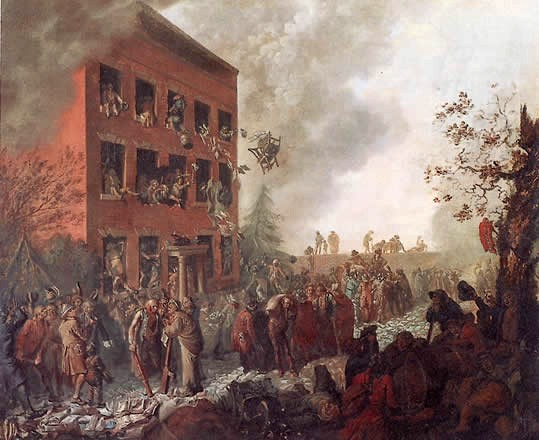
Rioters burned Priestley's home not for what he did, but for what he said about revolution.

Extremists are never bored.

Tom Junod’s remarkable piece on Fox News mogul Roger Ailes in Esquire magazine is well worth your time anyway, but for rhetoricians and students of political argument it’s pure gold–a look inside the head of the man who is largely responsible for the shape of American political discourse. It’s a long article but it pays back the effort with chestnuts like these:

What Roger Ailes has done at Fox is find a way to mainstream extremity for fun and, of course, for profit. He’s found out that people need the validating experience of extremity in the same way that he does. And he takes extreme positions and says extreme things because he needs to, because they allow him to make the choice that’s at the heart of his power.

If nothing else, Junod should be given an award of some kind for coming with a phrase that encapsulates so much about where American political discourse (and increasingly global political discourse) is today.  The “validating experience of extremity”– a notion big enough to capture both the vague anger of everyday people struggling to make the mortgage payment and the kind of madness that drove Jared Lee Loughner– is a phenomenon we should all be watching very closely.  There is perhaps no single, more important fact about the current political environment than that it is driven by this experience.

Happened across this lovely conversation on Philosophy TV this morning. (Oh the things one finds in one’s Twitter feed of a Sunday morning…) Nice to hear a logician of Priest’s caliber and notoriety (some would say infamy) in the mainstream philosophical world saying some of the same thing many argumentation theorists have said about formal logic and it’s presentation in the classroom.  Of course Priest winds up in a different place than informal logic, rhetoric, or pragma-dialectics but that doesn’t diminish the interest here.  Fair warning: this discussion is about an hour long.  It is, however, really interesting and surprisingly wide ranging.  Enjoy!

CFP: Progic 2011

Progic 2011 at Columbia University

The Progic conference series is intended to promote interactions between probability and logic. The fifth installment of the series will be held at Columbia University in New York on September 10th and 11th of 2011. While several of the earlier Progic meetings included a special focus, Progic 2011 will honor Haim Gaifman‘s contributions to the intersection of probability and logic. Progic 2011 will consist of 11 talks, 6 invited and 5 contributed. The following distinguished speakers have been confirmed:

Call for Papers: The five contributed papers will be selected from among the submissions that we receive. Submissions may be on any topic that is relevant to the interaction between probability and logic. Preference will be given to papers that make contact with at least one of the relevant themes in Haim Gaifman’s work. All submissions should be sent to progicconference2011@gmail.com by May 1 of 2011. Decision notices will be sent by June 1 of 2011.
Special Issue: We have made arrangements to publish all 11 papers from the conference in a special issue of the Journal of Applied Logic.
Local organizer: Jeff Helzner
Progic Steering Committee:


Defense Against the Dark Arts

The folks over at the blog Less Wrong use the term ‘dark arts’ to refer to the usage of knowledge about heuristics and biases, fallacies, and human rationality generally in a manipulative, destructive or otherwise sinister way.  A recent post there focuses on this manner of using presuppositions:

An excellent way of doing this is to embed your desired conclusion as a presupposition to an enticing argument.  If you are debating abortion, and you wish people to believe that human and non-human life are qualitatively different, begin by saying, “We all agree that killing humans is immoral.  So when does human life begin?”  People will be so eager to jump into the debate about whether a life becomes “human” at conception, the second trimester, or at birth (I myself favor “on moving out of the house”), they won’t notice that they agreed to the embedded presupposition that the problem should be phrased as a binary category membership problem, rather than as one of tradeoffs or utility calculations.

This sort of thing is nothing new to argumentation theorists, of course, but the explicit labeling of such maneuvers as “dark arts” may well be.  Argumentation theorists, rhetoricians, and informal logicians often think in terms of fallacies, mistakes or blunders instead, usually meaning to impute no moral status to such things.  In the main I think this is wise, as highly developed skill at arguing and avoiding fallacies and other such mistakes is rare. That being the case it would be deeply problematic to assume nefarious motives lying behind every fallacy.

Continue Reading »