Feeds:
Posts
Comments

Archive for the ‘Discussion’ Category

Well, you've got to admit that it's easy to work with from a theoretical perspective...

Creating explanatory or theoretical models of complicated phenomena is one of the chief intellectual activities of academics in nearly every field.  As we do this, it is salutary to remember that as powerful and helpful as our models can be they can also bewitch us too.  Rather than providing us with a lens that helps us see the phenomena we study more clearly, they can inflict a kind of selective vision on us that shackles us to our grounding assumptions, forces interpretation in their terms and blinds us to important bits of information that lie outside their boundaries.

Sometimes, this can be funny.  For example, I recall a bit of apocrypha about a philosopher who, upon first encountering black swans, rather than admit them as proof of that the conclusions of inductive arguments were underdetermined by their premises insisted instead that those black feathery things serenely gliding around on the water out there couldn’t possibly be swans at all.

Physicists are susceptible to this sort of thing too and they recognize it in this old and much beloved self-effacing joke.  It is funny, but I can’t help but think as well that lurking somewhere in there is a new fallacy patiently awaiting discovery by some intrepid researcher in argumentation theory.  Certainly being in the grips of a model is a common enough cause of poor argumentation to warrant designation as a fallacy of some kind.  I’m willing to start the process if you are.  Post a short description of your candidate for the new fallacy here in the comments section.  Best entry wins…er…let’s say eternal glory. 🙂
Read Full Post »

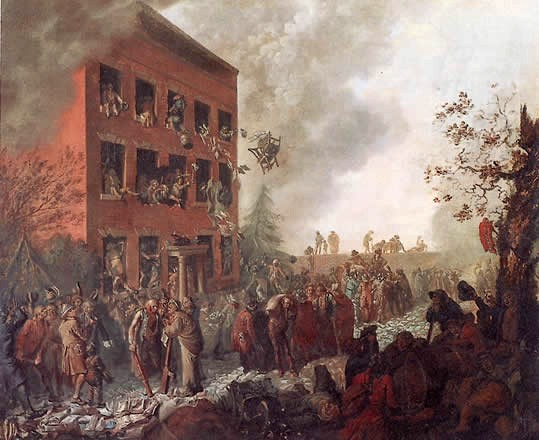
Rioters burned Priestley's home not for what he did, but for what he said about revolution.

Extremists are never bored.

Tom Junod’s remarkable piece on Fox News mogul Roger Ailes in Esquire magazine is well worth your time anyway, but for rhetoricians and students of political argument it’s pure gold–a look inside the head of the man who is largely responsible for the shape of American political discourse. It’s a long article but it pays back the effort with chestnuts like these:

What Roger Ailes has done at Fox is find a way to mainstream extremity for fun and, of course, for profit. He’s found out that people need the validating experience of extremity in the same way that he does. And he takes extreme positions and says extreme things because he needs to, because they allow him to make the choice that’s at the heart of his power.

If nothing else, Junod should be given an award of some kind for coming with a phrase that encapsulates so much about where American political discourse (and increasingly global political discourse) is today.  The “validating experience of extremity”– a notion big enough to capture both the vague anger of everyday people struggling to make the mortgage payment and the kind of madness that drove Jared Lee Loughner– is a phenomenon we should all be watching very closely.  There is perhaps no single, more important fact about the current political environment than that it is driven by this experience.

Read Full Post »

Happened across this lovely conversation on Philosophy TV this morning. (Oh the things one finds in one’s Twitter feed of a Sunday morning…) Nice to hear a logician of Priest’s caliber and notoriety (some would say infamy) in the mainstream philosophical world saying some of the same thing many argumentation theorists have said about formal logic and it’s presentation in the classroom.  Of course Priest winds up in a different place than informal logic, rhetoric, or pragma-dialectics but that doesn’t diminish the interest here.  Fair warning: this discussion is about an hour long.  It is, however, really interesting and surprisingly wide ranging.  Enjoy!

Read Full Post »


Now, here’s the thing.  I like Michael Sandel. I really do. (I even met him once, though I really, really doubt he would remember.) He’s done a lot to advance the cause of political communitarianism–a position that I respect immensely though I do not share it–and I generally regard him as a decent political philosopher.

Perhaps that’s why I have such a hard time sharing his optimism that the world’s democratic processes can be positively reformed if we simply replicate the Socratic teaching model he uses with a roomful of highly intelligent professionals in this TED session (or his classes at Harvard) with audiences throughout the world. It’s an idea that doesn’t live up to the rest of Sandel’s body of work.

That said, it’s not as though he doesn’t have a point. In a sense he’s right. We (in the US) generally have lost the art of public debate.  In my view that’s got a lot to do with our media culture, the state of our educational institutions, our particular political landscape at this point in history, and a host of other factors. I’m just not sure that the cure for what ails us is a re-instating of Aristotelian etiological vocabulary. Don’t get me wrong–I love Aristotle’s ideas too; rather more than Sandel’s in fact– but there’s something a bit too easy about Sandel’s approach to political deliberation here. The missing elements of this talk (and here I find myself thinking back to Jim Freeman’s ISSA keynote from last summer) only remind me, yet again, of how much “mainstream” moral and political philosophy could gain through an acquaintance with argumentation theory.

But maybe that’s just me. Perhaps I’m missing something in this talk, or I simply need a hug today or something.

Read Full Post »

Have a look at this short talk by David McCandless on data visualization:

There are a number of interesting things for argumentation theorists to think about here.  For one, if McCandless is right then clearly what he says is wind in the sails for those who rate argument diagramming highly among our various tools of analysis.

While watching this presentation I also found myself wondering if McCandless’ technique might provide aid and comfort to the cause of those who believe in visual arguments too.   To be clear, I don’t think that any of the visuals he presents here is an argument. He makes visual statements, sure, and at times draws inferences from them, but that would make his arguments (in my book at least) arguments with visual elements–not visual arguments per se.  Still I found myself wondering if maybe purely visual arguments might be a possible innovation that could come from the kind of work McCandless is doing, somewhere down the line.

Read Full Post »

Mulling over deep disagreement (again) I came across this nice little piece by David Suissa at the Huffington Post from a little over a year ago.  In it he talks about the traditional Jewish narrative of the houses of Shammai and Hillel, who differed over how to interpret the Jewish law (Shammai insisted on strict adherence, while Hillel counseled in favor of compassion):

This idea of looking at more than one “truth” is at the heart of the epic debate in the Talmud between the house of Shammai, which represents the strict, uncompromising voice of Jewish law, and the house of Hillel, which represents the more lenient voice.

Rabbi Moti Bar-Or, who runs Kolot, a bridge-building Torah study institution in Israel, explained to me that “the uniqueness of Hillel is that he truly believes there is validity in the Shammai approach, although he totally disagrees with him.”
In Shammai’s world, there’s “no room for pluralism” because it’s the world of “true or false.” It is Hillel’s ability to see the other side, Bar-Or says, that makes Judaism follow his approach today — not the fact that he was “smarter or right.”

(more…)

Read Full Post »

An interesting distinction is made by Andrew Cline in this recent post on his rhetoric and journalism blog, Rhetorica, between “punditry” and “opinion journalism”.

According to Cline, opinion journalism is reporting informed by or explicitly written from a particular political perspective.  It includes acting as a “custodian of fact” and observing a “discipline of verification”.  The offers this description of that discipline via a link to an older post:

A discipline of verification should be basic to any practice that we would understand as journalism. Practicing such a discipline means that journalists must be custodians of fact, i.e. journalists should get to the bottom of civic disputes by gathering and verifying facts rather than simply allowing interested sources to spout off. Journalists should protect the facts from those who would spin them, ignore them, or distort them. When journalists don’t practice this discipline, they are guilty of spinning, ignoring, and distorting, often in the name of fairness and balance.

As to being a custodian of fact, Cline has this to say in another older post on Rhetorica:

What I’m getting at here is this: facts are not necessarily easy things to nail down unless we’re measuring (and even then we can run into problems). […] There can be no argument over facts in themselves. We argue about how facts are measured and what facts mean. And we argue about assertions of fact until such assertions are established as fact. Reporters should consider the statements by sources as assertions of fact until such time as the reporter can establish them as facts. The news organization, then, should not publish unverified assertions without disclaimers or qualifiers.

In contrast to opinion journalism, according to Cline, punditry is simply about “winning politically” and does not include the imperatives to be a custodian of fact or to follow a discipline of verification.

(more…)

Read Full Post »

Cognitive dissonance is one of the best established notions in psychology.  Simply put (perhaps too simply) the idea is that people in general will go to almost any length to hold onto a cherished belief, no matter how strong the evidence against it is, and no matter how irrational the attempt to do so may seem (or actually be).   In a recent posting on his blog Ben Goldacre talks about a recent article in the Journal of Applied Social Psychology that focuses on this effect in cases where subjects dismiss well-founded scientific data that contradicts their beliefs.

While reading this discussion I kept returning in memory to a session I attended at ISSA a couple of weeks ago on deep disagreement. Two of the papers presented focused extensively on strategies for resolving deep disagreements.   David Zarefsky presented a battery of strategies none of which, interestingly, involved a direct attack on the belief(s) at the heart of the disagreement.  Manfred Kraus’s proposal was that deep disagreement be dealt with by “anti-logical” reasoning after the fashion of the Sophist, Protagoras.   I’m no expert on the Sophists but as I understood the paper Kraus seemed to be suggesting that in anti-logical reasoning it’s not so much the partisans of the contradictory views that work out their disagreement as it is the audience to the dispute, who act in the role of judge.

(more…)

Read Full Post »

ISSA 2010: A Note

So, about that “live from ISSA” thing…

Yeah, that kinda didn’t happen.  Perhaps it was the punishing heat, abnormal for Amsterdam at this time of year.  Perhaps it was jetlag.  It may even have been that the papers were so incredibly interesting that the poor writer’s brain simply collapsed under the strain at the end of each day.  Or it might have been bewitchment at the charm and beauty of this famous city.  Perhaps it was all of these. We will never know.  All that can be done at this point is to beg the good reader’s indulgence.  It was rather more challenging to find the time to write than I expected.

Prior to coming here I had heard many things about what to expect, and it turns out that all of the nice things I heard were true.  The Dutch are friendly and relaxed, the cafes are excellent, and the city truly is beautiful by day and by night, offering enough history, art, and architecture to make one wonder just why there is so much activity in that one part of town, anyway.  The city certainly deserves to be on everyone’s travel agenda.  It is lovely.

ISSA too, was pleasant and highly rewarding.  I spent most of my time over the three days in sessions on rationality and reasonableness and argument schemes. I  heard quite a few interesting papers. I may write about some of them later here once I’ve had time to sit down, look over my notes, and think through them again. In addition to the papers, there were a great many conversations, at lunch and at receptions and informal gatherings too at which I learned a good deal.  These, in addition to being remarkably pleasant despite the heat, and a testament to the fundamental good will of argumentation theorists generally, were often as enlightening as the sessions themselves.

All in all it was a great conference in a fine city.  With any luck I’ll be able to make a return trip in 2012. That is, of course, provided the Aztec god doesn’t jump out of the Mexican jungle and devour the world before then.  It would be a shame if that did happen.  Those pancakes really are fantastic. 🙂

Read Full Post »

RAIL @ ISSA 2010

Hello all,

As many of you are no doubt aware, ISSA 2010 is but a couple short weeks away.  I will be there, and hope to do some postings live from the event (IF I can find free or at least very cheap wi-fi access).  The aim of these posts will be to give those who cannot attend ISSA a snapshot of the goings-on there, as well as to provide a forum for continuing conversation for participants and attendees.

Certainly I’ll be including summaries of keynote presentations as I will be present for all of them, but I’m curious to know which other aspects of the conference you might be interested in reading about here.  If no one posts anything you’ll just get my take on the papers I want to see (caveat emptor!). 🙂 If there seems to be a lot of interest in particular topics or papers though I’ll make an effort to get to those sessions and write about them too.

So, is there anything in particular at this year’s ISSA conference that you’d like to see covered here at RAIL?  If so, post here and I’ll do the best I can to honor the requests with the most support. If this goes well, I’ll do something similar for OSSA 2011 next year too.

Read Full Post »

« Newer Posts - Older Posts »