Feeds:
Posts
Comments

Archive for the ‘Connections’ Category

Apollo and the Muses by Hans Holbein the Younger, 1533

The world of those who study argument and who study reason and rationality is abuzz with talk of the provocative research of Hugo Mercier and Dan Sperber. Anyone who was at last week’s OSSA conference heard their names in practically every other conversation or presentation. For my own part I’m not sure quite what to make of their work.  On the one hand it’s exciting to see argument and reason brought together in empirical research, and I’m well on record as being very friendly to the notion that argument has a very deeply rooted functionality for human beings at both the collective and individual levels. On the other hand, I’m not sure that there aren’t grave problems lurking within. For one, Mercier and Sperber seem at times to work from the assumption that ‘argument’ means ‘deductive argument’ and if this is so, I’m not at all sure that it is wise.  The body of work on analogy alone would give me pause regarding the prospects of such a view, to say nothing of the work of the informal logic movement in the last 30 years.  There are other things that trouble me, but as I’m still doing research in this general idea I’ll try to save myself what might turn out to be a super-sized helping of crow and leave the reader to their own devices where Messrs. Mercier and Sperber are concerned.

At any rate there’s no denying it’s relevance to the world of argumentation theory.  In that vein this video interview with Hugo Mercier is one that I expect will be of interest to many.  The interview is located at the web journal* Edge, itself worth a look to those with an interest in interdisciplinary intellectual discourse.

*(All apologies to those of you who thought that by ‘Edge’ I was referring to an Irish fellow–though I confess I probably would have watched that interview with interest too.)

Read Full Post »

OSSA 2011 is now officially in the bag.  It was a good week. With such a high volume of papers presented it’s possible to follow many trajectories, but these were my highlights:

The Ambassador Bridge

  • Attending a pre-conference workshop on normative pragmatics with Jean Goodwin and Beth Innocenti. Jean and Beth did a fantastic job explaining their views and those of Fred Kauffeld, with whom I was also fortunate enough to chat with at length. Even having known something of these views before, I left considerably enriched for the experience, and convinced that normative pragmatics is a research program that deserves a lot more investigation and development.
  • Discourse analyst Karen Tracy’s keynote address on reasonable hostility in public hearings was also rich with ideas that I intend to think a lot more about in the coming weeks–especially her conception of how issues move through phases of being unarguable (unreflectively taken as settled), arguable (manifestly unsettled or controversial) and then unarguable again (settled sufficiently for the public discussion to move on).  This is not to say that the other keynotes were not also worthwhile–they were. Paul Thagard’s effort to bring a neuropsychological viewpoint to the discussion over the nature of critical thinking was timely, and David Hitchcock’s presentation of his work on inference claims was as interesting and challenging as those who know his work would expect it to be. (You can read the abstracts of the keynotes here.)
  • Having the chance both to attend Maurice Finocchiaro’s session on deep disagreement and to chat with him about it afterwards was illuminating.  As readers of this blog will know, deep disagreement is one of my areas of interest within argumentation theory. Finocchiaro’s work, which will be part of a forthcoming book on meta-argumentation, moves the discussion of deep disagreement forward in what I think are all the right ways.  I’m very glad he’s taken the problem on in the way that he has.
  • Of course I have to thank the wonderful audience that attended my presentation on the history of conductive argument and reflective equilibrium as well. We had an excellent discussion from which I learned much that I will bear in mind as I carry forward my work on this and other projects.

Finally, no discussion of an OSSA conference would be complete without mention of the enormous camaraderie and good will that animates these events.  Coming away from this iteration of OSSA I am reminded of my initial impression that the argumentation community models what I think are scholarly ideals of diversity of approach, internationality and interdisciplinarity.  Of course, we have our divisions and competitive moments just like any other body of scholars.  This is only natural among diverse people who care deeply about what they study and who struggle to get it right.  What is impressive about argumentation theory is that these divisions enliven the discussions rather than hamper them.  In many ways, these gatherings are as much gatherings of friends as they are academic gatherings. Thus, though I won’t try the reader’s patience with a long list of names, I will close this entry by saying how glad I am to have had the chance to catch up with so many old friends, and to have made so many new ones. All in all, it was a week well spent. I look forward to the next one.

Read Full Post »

Rhetoric and argumentation don’t usually seem like tools of war.  Typically, we think of them as ways of preventing war; of wars as something that happens when rhetoric and

German stamp showing the pen and sword together, via Wikimedia Commons

argumentation (under form of diplomacy) fail.  A recent article changes this picture entirely. “Information Operations”, or “IO”: military operations with the general goal of influencing or compromising the decision making of adversaries or of protecting one’s own decision making from such interference, are now an openly acknowledged part of what the US military (and one would assume, that of many other nations) does. The article, “Military Social Influence in the Global Information Environment: A Civilian Primer” by Sara King, appears in the August 2010 issue of the journal Analyses of Social Issues and Public Policy and gives a strikingly detailed overview of IO. King supports her overview with ample evidence from actual uses of IO in current, and in some cases even ongoing conflicts. The article can be read online here in its entirety (at the time of this writing). Psychologist Vaughan Bell also has an interesting write up about the article on the blog Mind Hacks.

As King notes, it isn’t necessarily news that the military does this. What is news is the degree to which they do it comprehensively, and the degree to which the management of public opinion both abroad and at home is the focus of ongoing military concern.

This, I think, is something which scholars of argument and rhetoric should take very seriously. It raises a number of hard questions. Many will no doubt be horrified by the military’s use of techniques of persuasion across the smallest and largest of scales, but if the desired result is less use of lethal force, then how strenuous should those objections be made?  Similarly, while one might not object to IO aimed at making it harder for terrorists to recruit new members to their causes, it does to some degree compromise the autonomous decision making processes of the individuals involved–and isn’t this the very basis on which we would object to being subject to similar manipulations?  Does the fact that we are “at war” make it alright to do this? If so, why? To what degree?  And what does knowing that these kinds of operations are going on all the time do to our trustworthiness in traditional media outlets and the institution of journalism overall?  These and other questions, I think, are well worth our time. No matter how we answer them, the fact remains that some of the techniques we teach are now, for better or for worse, openly acknowledged weapons of war. It’s worth considering whether or not the ethical approach we take to teaching them needs reevaluation in that light.

Read Full Post »

The Ambassador Bridge, via Wikimedia Commons. Original by Mike Russell, CC 3.0 S-A

As many in the argumentation studies community know next week is OSSA 9, one of the bigger events on our calendars.  The conference theme this go around is “Argumentation, Cognition and Community”.  Having had a look at the schedule I think this promises to be an interesting conference. Many leading scholars in argumentation, informal logic, rhetoric, and normative pragmatics will be there presenting and responding to papers.  There is also a good range of strong papers by up and coming scholars as well.  This is one to look forward to, if you’ll be coming.

All the pertinent information for OSSA, including .pdf downloads of the schedule and abstracts among other things, can be accessed here.

Unfortunately, as we all know, not everyone who would like to attend can attend.  These are tough times and many of us find ourselves at institutions who can’t always support travel to events like these as often or to the degree that they would wish. For those who won’t be coming but want to follow along, I thought I might propose a conference back-channel on Twitter with the hashtag #OSSA2011.  Those of us who have Twitter accounts and will be there could post about discussions, sessions, workshops, and everything else OSSA between sessions or whenever else we have the chance.  That way those who cannot come can follow along. An added benefit is that those of us who are there will be able get to know each other a little better and to coordinate a little easier when it comes to dinner plans, taxi rides, etc.. (To get a better idea of how it works, you might check out this post from the innovative and consistently helpful ProfHacker blog on the Chronicle of Higher Ed website.)

If you’re interested, let me know!  You can comment here or post to Twitter including “#OSSA2011” somewhere in your tweet.

Read Full Post »

"carrier pigeons" with messages attached. Harper's New Monthly Magazine, No. 275, April, 1873. via Wikimedia Commons

Thankfully, messaging technology is now far more advanced than this.

Recently I had the pleasure to participate in an online argumentation colloquium. We used Skype for the actual video interaction and Dropbox to share files before, during, and after the event. Frank Zenker (also an author here) was the driving force behind the project. Jean Goodwin, Bart Verheij, Frank, and myself all did presentations or read papers which we then discussed. It is safe to say that all participants unanimously regarded the event as a success.  You can read Frank’s excellent summary of the experience and what we learned by doing it in Informal Logic here or by downloading the pdf (containing screen-shots of the event) from his website here.

As those with a scholarly interest in argumentation know, our peers and friends in this field are scattered across the entire planet. Other areas of research can say the same thing of course, but in many cases the number of folks working in those areas is such that getting together doesn’t necessarily require extensive international travel.  Often, unless a scholar in argumentation studies has the good fortune to be located near a university-sponsored institute or grad program like the ones at the University of Windsor, UVA or Lugano, one has to wait until a conference to see one’s colleagues and have the chance to discuss works in progress.  Put that together with the increasing financial constraints most of us find ourselves under, with the environmental impacts of all those plane, train, and taxi rides, and with the increasing quality, availability, and ease of use of the requisite software, and the idea of online collaboration of the sort we tried starts to make more and more sense.

It seems clear that online colloquia couldn’t take the place of large scale gatherings like ISSA, OSSA, the RSA or ArgMAS. Still, they’re a great way to stay in contact and work collaboratively to move our research programs forward.  At least, that’s what we think.  What do you think? Would you be open to participating in or hosting events of this kind? Perhaps you’ve already tried this sort of thing. If so, how did it go for you?

Read Full Post »

2011 Workshop in Computational Models of Natural Argument

The 2011 CMNA workshops will be held concurrently with the 25th AAAI Conference in San Francisco, CA,  August 7-11.

Description

The series of CMNA workshops, since its inception in 2001, has been acting to nurture and provide succor to the ever growing community working in “Argument and Computation”. AI has witnessed a prodigious growth in uses of argumentation throughout many of its subdisciplines: agent system negotiation protocols that demonstrate higher levels of sophistication and robustness; argumentation-based models of evidential relations; groupwork tools that use argument to structure interaction and debate; computer-based learning tools that exploit monological and dialogical argument structures in designing pedagogic environments; decision support systems that build upon argumentation theoretic models of deliberation to better integrate with human reasoning

The CMNA workshop series has seen a notable growth in submissions, and forms a complement to more recent series or events, like the ArgMAS series, begun in 2004, and the nascent COMMA series, which held its first meeting in 2006. CMNA keeps a broader, interdisciplinary emphasis on natural (real) arguments and the computational tools and techniques for modeling, manipulating and exploiting them. (more…)

Read Full Post »

This lovely little RSA animation featuring linguist Sephen Pinker should be interesting for theorists of argument on multiple levels.  Such explanations as Pinker’s bear directly on how we take on enthymemes, how we think about dialectical guidelines, how we think about the practice of argumentation in general, etc.  I could go on, but instead I’ll let the charming video do the work*:

Direct Link: YouTube – RSA Animate – Language as a Window into Human Nature.

*Those who have heard me prattle on about David Lewis’s Convention in the recent past are hereby excused, but should watch anyway because of how cool these RSA animate thingies are. 🙂

Read Full Post »

Anna Elizabeth Dickinson (1842-1932), the first woman to address the US Congress was by all accounts "a gifted orator".

Many in the field of rhetoric, I’ll wager, are happy to see an article about their discipline at all in a major newspaper like the Guardian.  Being a philosopher myself I sympathize with the sort of small-town-ish “Hey! They’re talking about US!!” feeling engendered by articles like Mary Beard’s What makes a great speech?

The article itself, however, is rather a letdown in terms of what it communicates to the reader about rhetoric.

Let me begin in fairness by noting that Mary Beard is a well-known classicist in the UK.  Thus it is not surprising that her treatment of rhetoric here focuses primarily on sources and examples drawn from Greco-Roman antiquity.  Be this as it may, she speaks in a general voice here about rhetoric and so her discussion is disturbingly incomplete. Rather than showing rhetoric as the very active and modern discipline that it is, her focus on the ancients gives the impression that the study of rhetoric ended with Cicero. She makes no mention at all of any figures in the history of rhetoric between antiquity and the present day. Not even foundational figures of contemporary rhetoric like Perelman and Olbrechts-Tyteca, get a mention, to say nothing of figures lesser known outside rhetoric but equally if not more important within it like Burke, Richards, Toulmin, or Henry Johnstone Jr..  Though to her credit she avoids rehashing the standard Platonist objections to rhetoric, Beard’s presentation is rendered somewhat shallow by her lack of modern sources.  (more…)

Read Full Post »

Scottish Argumentation Day

The 2011 Scottish Argumentation Day will take place at the University of Aberdeen on the 4th of March in Room A31 of the Taylor Building (lunch will be provided). Scotland contains a number of world leading centres for argumentation research, and the purpose of the day is to bring together students, post-doctoral researchers and established scientists from these groups  to discuss their work, obtain feedback on it, and forge new collaborations.

The format of the day will depend on those attending. However, it is envisioned that participants will be invited to give brief presentations, followed by informal discussion sessions in the afternoon.

The event is free to all, and  anyone with an interest in argumentation is welcome to attend. If you are interested in coming along, or for further details, please contact Nir Oren (n.oren at abdn.ac.uk).

Dr. Nir Oren
Department of Computing Science
University of Aberdeen
AB24 3UE

http://www.csd.abdn.ac.uk/~niroren/

Read Full Post »

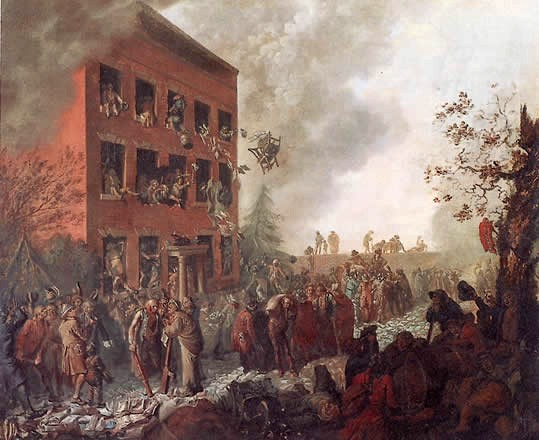
Rioters burned Priestley's home not for what he did, but for what he said about revolution.

Extremists are never bored.

Tom Junod’s remarkable piece on Fox News mogul Roger Ailes in Esquire magazine is well worth your time anyway, but for rhetoricians and students of political argument it’s pure gold–a look inside the head of the man who is largely responsible for the shape of American political discourse. It’s a long article but it pays back the effort with chestnuts like these:

What Roger Ailes has done at Fox is find a way to mainstream extremity for fun and, of course, for profit. He’s found out that people need the validating experience of extremity in the same way that he does. And he takes extreme positions and says extreme things because he needs to, because they allow him to make the choice that’s at the heart of his power.

If nothing else, Junod should be given an award of some kind for coming with a phrase that encapsulates so much about where American political discourse (and increasingly global political discourse) is today.  The “validating experience of extremity”– a notion big enough to capture both the vague anger of everyday people struggling to make the mortgage payment and the kind of madness that drove Jared Lee Loughner– is a phenomenon we should all be watching very closely.  There is perhaps no single, more important fact about the current political environment than that it is driven by this experience.

Read Full Post »

« Newer Posts - Older Posts »