Feeds:
Posts
Comments

Archive for the ‘Argumentation’ Category

7th eColloq on Argumentation
Thursday April 11, 4-6 pm GMT+1  (Amsterdam, Berlin, Rome, Stockholm)
 
PROGRAM
4.00-4.10 Connect, Welcome
 
4.10-4:35 Bart Verheij (Groningen, The Netherlands):
Defeasible rule-based arguments with a logico-probabilistic foundation
 
Abstract: A theory of defeasible arguments is proposed that combines logical and probabilistic properties. This logico-probabilistic argumentation theory builds on two foundational theories of nonmonotonic reasoning and uncertainty: the study of nonmonotonic consequence relations (and the associated minimal model semantics) and probability theory. A key result is that, in the theory, qualitatively defined argument validity can be derived from a quantitative interpretation. The theory provides a synthetic perspective of arguments `jumping to conclusions’, rules with exceptions, and probabilities. The approach is compared to Pollock’s computational model of argumentation OSCAR, designed on the basis of his well-developed positions concerning the relations between argumentation, logic and probability. In contrast with Pollock’s OSCAR, the present approach is compatible with the standard probability calculus.
 
4:35-4:50 Discussion
 
4:50-5:00 Break
 
5:00-5:25 Emmanuel J. Genot (Lund University, Sweden):
The Myth of a Confirmation Bias (Arguments for a better argumentative theory of reasoning)
 
Abstract: Wason, confronted with an apparent instance of the Fallacy of Affirming the Consequent in his empirical Selection Task, hypothesized a “Confirmation Bias” (CB) to be responsible for subjects’ selections [4]. When Bayesian rational analysis of the selection task (RAST, [3]) substituted a richer probabilistic semantics to Wason’s truth-functional semantics, subjects’ selection emerged as being vindicated, and evidence for CB (in fact, any bias) vanished. Relevance Theorists later produced data that Bayesian models could not accommodate [1], yet without exhibiting evidence for biases of any sort. However, Relevance Theory has more recently been superseded by the Argumentative Theory of Reasoning (ATR, [2]), in which CB has returned with a vengeance, backed by an evolutionary narrative that pits “argumentative” and “logical” competences against one another. I will argue that this narrative is a remnant of the same truncated view of logic (and semantics) that informed Wason’s theorizing, but that argumentation-theoretic considerations are necessary to account for the data. To support this view, I will present a generalization of RAST that accounts for both standard and non-standard cases of ST (resp. from [3, 4] and [1]) once argumentative goals are “factored in,” but with an underlying semantics that undermines the very idea of “logical competence”—without which the CB is but a myth.
 
Girotto, Kemmelmeier, Sperber & van der Henst. “Inept reasoners or pragmatic virtuosos? Relevance and the deontic selection task”, Cognition, 2001, 81, B69-B7
Mercier & Sperber, Why do humans reason? Arguments for an argumentative theory. Behavioral and Brain Sciences, 2011, 34, 57-74.
Oaksford & Chater. A Rational Analysis of the Selection Task as Optimal Data Selection. Psychological Review, 1994, 101, 608-631
Wason, Reasoning About a Rule. Quarterly Journal of Experimental Psychology, 1968, 20, 273-281
 
5:25-5:40 Discussion
 
Discussants (preliminary list)
Nir Oren (University of Aberdeen, UK)
David Hitchcock (McMasters, Canada)
Thomas Gordon (Berlin, Germany)
Jean Goodwin (Iowa State, USA)
Iowan Drehe (University of Cluj-Napoca, Romania)
Sune Holm Petersen (Copenhagen University, Denmark)
Steven Patterson (Marygrove College, Detroit, USA)
Sarah Uckelman (Ruprecht-Karls Universität Heidelberg, Germany)
Marcin Lewinski (New University of Lisbon, Portugal)
Thomas Fischer (University of Houston, Texas, USA)
 
PARTICPATION
To participate as a discussant (just “sitting in” is in fact fine!), please review the links under “TechThings” at the above website (to test your hardware) and contact the organizer at frank.zenker@fil.lu.se.
 
ORGANIZER
Frank Zenker
Department of Philosophy & Cognitive Science
Kungshuset, Lundagård, 222 22 Lund, Sweden
Read Full Post »

Fourth International Workshop on Logic, Rationality and Interaction

Submission deadline: Saturday, June 1 2013

Conference date(s):
Wednesday, October 9 2013 – Saturday, October 12 2013

Center for the Study of Language and Cognition, Zhejiang University

Hangzhou, China

The LORI workshop series aims at bringing together researchers working on a wide variety of logic-related fields concerned with the understanding of rationality and interaction. These include Game Theory and Decision Theory, Philosophy and Epistemology, Linguistics, Computer Science and Artificial Intelligence. The series aims at fostering a view of Logic as an interdisciplinary endeavor, and supports the creation of a Chinese community of interdisciplinary researchers.

We invite submissions of contributed papers bearing on any of the broad themes of the LORI workshop series. More specific topics of interest for this edition include but are not limited to: (more…)

Read Full Post »

4th Summer Institute On Argumentation:-

Multi‐Modal Arguments: Making sense of images (and other non‐verbal content) in Argument

May 27-31, 2013 

  • Can works of art, films, virtual realities and other kinds of non-verbal content operate as arguments?
  • Why have some objected to this suggestion? What can we learn from their objections?
  • How can the various theoretical perspectives that make up argumentation theory, such as informal logic, rhetoric, dialectics, dialogue theory, and discourse analysis, account for multi-modal arguments?
  • How can we construct a comprehensive theory of argument that makes room for, explains, and allows us to assess, arguments of this sort?

In conjunction with the tenth OSSA (Ontario Society for the Study of Argument) conference, CRRAR will offer a summer institute on multimodal arguments.

One trend in the development of argumentation theory is an  increasingly broad conception of argument which recognizes (among other things) the use of “multi-modal”  elements – images, music, and other non-verbal components – as key components of many arguments. In this course we consider the questions that this raises. (more…)

Read Full Post »

CALL FOR PAPERS FOR THE 8th ISSA CONFERENCE ON ARGUMENTATION

From July 1 to July  4, 2014, the 8th Conference of the International Society for the Study of Argumentation (ISSA) will be held at the University of Amsterdam. The aim of the conference is to draw together scholars from a variety of disciplines that are working in the field of argumentation theory.

The keynote speakers are:

Frans H. van Eemeren (University of Amsterdam & ILIAS)
J. Anthony Blair (University of Windsor)
Jeanne Fahnestock (University of Maryland)

The planning committee of the 8th ISSA Conference invites presentations of original, non-published work on argumentation. Argumentation theorists, (informal) logicians, discourse analysts, communication scholars, rhetoricians, legal scholars, AI scholars, and other scholars involved in the study of argumentation are all encouraged to take part.

Anyone who wishes to present a paper can submit an abstract in English to the planning committee via the following website: www.conftool.pro/issa2014. Abstracts (max. 300 words), prepared for blind refereeing, must be submitted no later than October 1, 2013.

Among the conference themes are:

  • Argument schemes
  • Argumentation structures
  • Fallacies
  • Theoretical issues
  • Argumentative strategies
  • Argumentation and stylistics
  • Ethos and pathos in argumentation
  • Analysis of controversies
  • Argumentation in debate
  • Persuasion research
  • Interpersonal argumentation
  • Visual argumentation
  • Religious argumentation
  • Argumentation and epistemology
  • Argumentation in the media
  • Argumentation in a medical context
  • Argumentation in a legal context
  • Argumentation in a political context

The planning committee consists of Francisca Snoeck Henkemans, Bart Garssen, Gordon Mitchell and David Godden. Further information on the 8th ISSA Conference will be available at: http://www.hum.uva.nl/issa. The address of the planning committee is: University of Amsterdam, Department of Speech Communication, Argumentation Theory and Rhetoric, Spuistraat 134, 1012 VB Amsterdam, email: issa-fgw@uva.nl.

Read Full Post »

Two new lectureship openings for folks with competence in computational approaches to argumentation (broadly construed) have been posted at ARG:Dundee.  They are here and here.  Good luck!

Read Full Post »

4th Summer Institute On Argumentation:-

Multi‐Modal Arguments: Making sense of images (and other non‐verbal content) in Argument

May 22-25, 2013

  • Can works of art, films, virtual realities and other kinds of non-verbal content operate as arguments?
  • Why have some objected to this suggestion? What can we learn from their objections?
  • How can the various theoretical perspectives that make up argumentation theory, such as informal logic, rhetoric, dialectics, dialogue theory, and discourse analysis, account for multi-modal arguments?
  • How can we construct a comprehensive theory of argument that makes room for, explains, and allows us to assess, arguments of this sort?

In conjunction with the tenth OSSA (Ontario Society for the Study of Argument) conference, CRRAR will offer a summer institute on multimodal arguments.

One trend in the development of argumentation theory is an  increasingly broad conception of argument which recognizes (among other things) the use of “multi-modal”  elements – images, music, and other non-verbal components – as key components of many arguments. In this course we consider the questions that this raises.

Lectures and discussion will emphasize the development of perspectives that can be used to analyze, explain and evaluate such arguments, and on the analysis of concrete examples of multi-modal arguments and will consider objections to “visual arguments” and other forms of multi-modal argumentation. (more…)

Read Full Post »

As many will be aware, two weeks ago the Centre for Research in Reasoning, Argumentation and Rhetoric (CRRAR) hosted a symposium on Mercier and Sperber’s argument-based theory of reasoning at the University of Windsor.  Hugo Mercier himself gave the keynote. The panelists were Ian Hacking, Burkhard Schafer, Mark Aakhus, and Lori Buchanan. The co-chairs were Doug Walton and myself. The event took place over two days. The first day was a public presentation and discussion of the theory. The center of the second day’s events was an open (but moderated) roundtable discussion on the theory in which the speakers, CRRAR fellows, and guests all participated.  Both days saw intense, but very stimulating and rewarding conversations.

Spurred by several requests from abroad, we decided to have the events of the first day recorded so that they could be shared with the entire argumentation studies community. I am pleased to be able to announce that that video is now available.  You can watch it by clicking here. Unfortunately, however, there were technical problems with the camera that resulted in our not having usable video. That said, the audio quality is good and the slides for the keynote presentation are synced so that they can be followed with the talk. The panelists’ responses to the keynote presentations are still included too. They were excellent and are well worth the listening.

Thanks again to all who participated, attended, and in other ways great and small helped to make it a great weekend!

Read Full Post »

The Evolution of Argumentation: The Sperber-Mercier Theory

5-6 October 2012

University of Windsor, Windsor, ON, Canada

Keynote Speaker: HUGO MERCIER, University of Neuchâtel

Panelists:

  • Dr. Mark Aakhus, Communications, Rutgers University
  • Dr. Lori Buchanan, Psychology, University of Windsor
  • Dr. Ian Hacking, Philosophy, University Professor Emeritus, University of Toronto; Permanent Chair in the History and Philosophy of Scientific Concepts, Collège de France.
  • Dr. Burkhard Schafer, Computational Legal Theory, School of Law, University of Edinburgh

Chairs:

  • Dr. Douglas Walton, CRRAR & Assumption Chair in Argumentation Studies, University of Windsor
  • Dr. Steve Patterson, Philosophy, Marygrove College, Detroit.

Sponsored by:
THE CENTRE FOR RESEARCH IN REASONING, ARGUMENTATION, AND RHETORIC (CRRAR)

For more information contact: crrar@uwindsor.ca

Read Full Post »

Call for Papers: JURIX 2012

http://conference.jurix.nl/2012/cfp.html

The 25th International Conference on Legal Knowledge and Information Systems
University of Amsterdam, The Netherlands, 17-19th December 2012

Celebrating 25 years of supporting and enhancing cutting edge research in the interface between law and computer technology, the 2012 JURIX  conference will return to its roots in Amsterdam. We invite submission of original papers on the advanced management of legal information and knowledge, covering foundations, methods, tools, systems and applications for the following (non-exhaustive) list of topics: (more…)

Read Full Post »

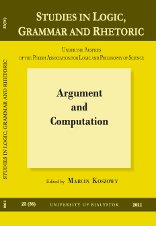
RAIL is pleased to recommend the Special Issue of Studies in Logic, Grammar and Rhetoric on Argument and Computation.

If, for some reason, you’re not yet paying attention to the things that are happening in the computation-based wing of argumentation theory, let me ever-so-humbly suggest that you should be. The excellent work being done in this area integrates not only key insights from mainstream contemporary argumentation theory but key insights from the ever-developing field of non-monotonic logic too.  Well and truly gone are the days when, as applied to logic, ‘formal’ meant ‘classical’.  This is truly exciting stuff.  Those with no background in the overlap between argumentation and computation may wish to begin with Chris Reed and Marcin Kosowy’s excellent introduction.  Following that, I would recommend Doug Walton’s article, “How to Refute an Argument in Artificial Intelligence” and Marcin Lewinsky’s article too as being particularly friendly to those whose background is heavier in argumentation and/or dialectics (per the Walton-Krabbe model) than in computation as next steps.

This issue is special in that it shows the relevance of computational approaches to nearly every branch of argumentation theory. To look at what some would consider extremes, for example, formal logic is represented in Kazimierz Trzęsicki’s excellent treatment of the problem of argument classification, but so is rhetoric in the article by Katarzyna Budzyńska and Magdalena Kacprzak, that represents the latest extension of their work at the time of this writing.

It is timely too. For those who have an interest in the way that argumentation is carried out through the medium of the internet this issue will be very useful indeed. The aforementioned article by Lewinsky covers this ground as does the article by Karolina Stefanowicz.  Those interested in contemporary pragma-dialetctics will also find much to pique their interest here, especially the article by the team of Jacky Visser, Floris Bex, Chris Reed and Bart Garssen.

Though of course the computational wing of argumentation theory is established and thriving in departments all over the world, I think this issue of Studies in Logic, Grammar and Rhetoric also shows the variety of good things that are happening in what is becoming the vibrant argumentation theory community of Warsaw. We should all be paying attention.

Read Full Post »

« Newer Posts - Older Posts »