Call for Papers: 2011 Workshop on Explanation Aware Computing
Click on the flyer below for more info, including workshop themes and submission deadlines.

CFP Flyer
Posted in CFP, tagged ExaCT, ExaCT 2011, explanation aware computing on January 25, 2011| Leave a Comment »
Call for Papers: 2011 Workshop on Explanation Aware Computing
Click on the flyer below for more info, including workshop themes and submission deadlines.
CFP Flyer
Posted in Announcements, tagged argumentation journals, Cogency, informal logic journals, Wittgenstein on January 22, 2011| Leave a Comment »
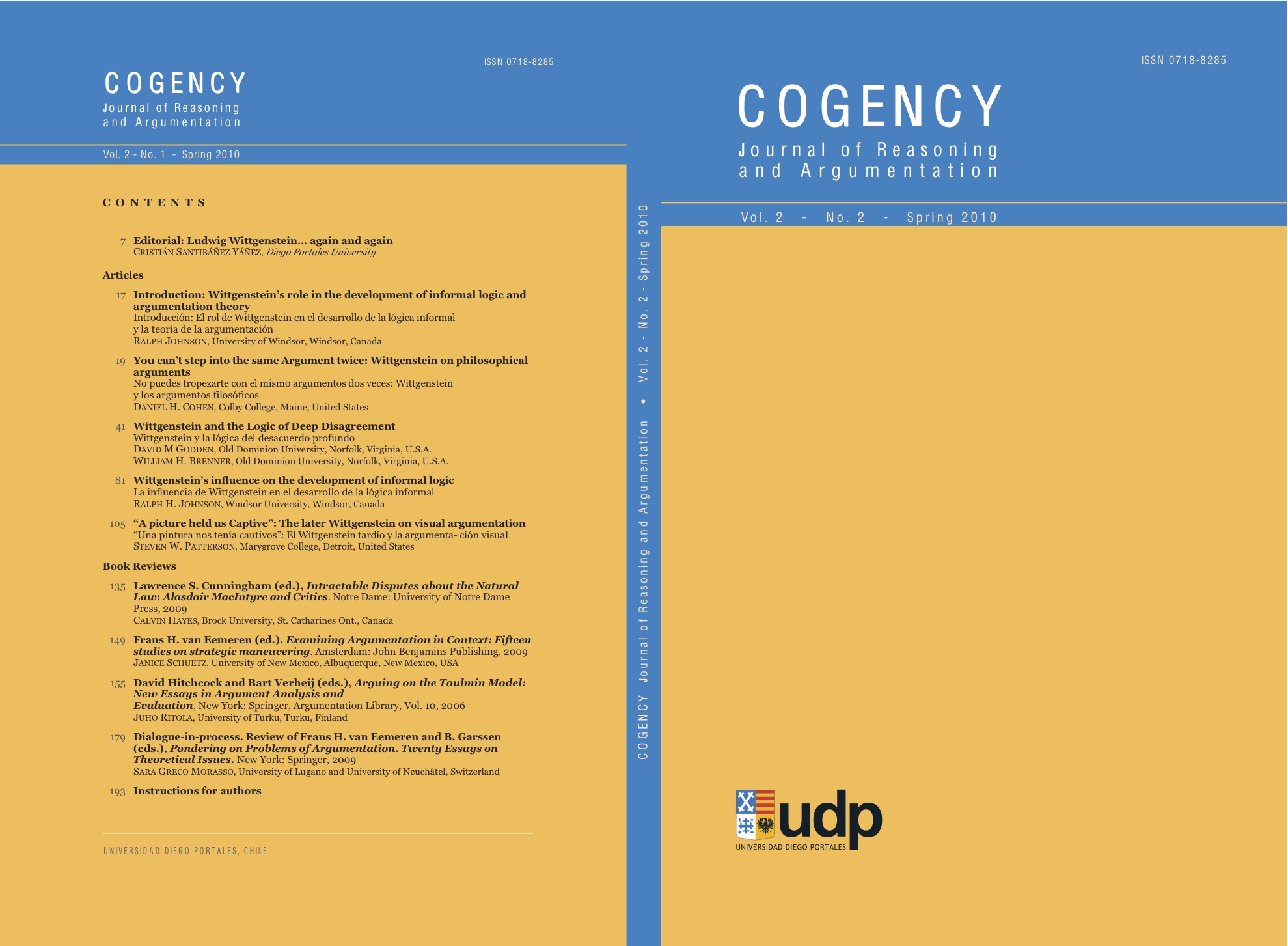
Cogency Vol. 2 No. 2: Special Issue on Wittgenstein and Argumentation
The latest issue of the journal Cogency focuses on the relationship between the philosophy of Ludwig Wittgenstein and argumentation theory. Having had the good fortune to write one of the articles myself and thereby to have an early look at the contents, I feel confident in saying that it’s a pretty interesting issue. Click on the image above for an enlarged view of the table of contents.
As part of the mission of RAIL is to keep readers informed of new publications, journals, and articles of interest, I’ve arranged with the editor to post announcements here when new issues of Cogency become available. I’ll be doing the same thing for Informal Logic. If you’d like to have your informal logic/argumentation-themed journal similarly featured please drop me a line and let me know.
For now, those interested in some past issues of Cogency can peruse their tables of contents here: Cogency Vol. 1, No 1 and here: Cogency Vol.2, No 1.
Posted in Connections, Discussion, Rhetoric, tagged Esquire Magazine, Fox News, political discourse, pundits, Rhetoric, Roger Ailes, television on January 18, 2011| Leave a Comment »

Extremists are never bored.
Tom Junod’s remarkable piece on Fox News mogul Roger Ailes in Esquire magazine is well worth your time anyway, but for rhetoricians and students of political argument it’s pure gold–a look inside the head of the man who is largely responsible for the shape of American political discourse. It’s a long article but it pays back the effort with chestnuts like these:
What Roger Ailes has done at Fox is find a way to mainstream extremity for fun and, of course, for profit. He’s found out that people need the validating experience of extremity in the same way that he does. And he takes extreme positions and says extreme things because he needs to, because they allow him to make the choice that’s at the heart of his power.
If nothing else, Junod should be given an award of some kind for coming with a phrase that encapsulates so much about where American political discourse (and increasingly global political discourse) is today. The “validating experience of extremity”– a notion big enough to capture both the vague anger of everyday people struggling to make the mortgage payment and the kind of madness that drove Jared Lee Loughner– is a phenomenon we should all be watching very closely. There is perhaps no single, more important fact about the current political environment than that it is driven by this experience.
Posted in CFP, tagged Journal of Applied Logic, Progic, Progic 2011 on January 4, 2011| Leave a Comment »
The Progic conference series is intended to promote interactions between probability and logic. The fifth installment of the series will be held at Columbia University in New York on September 10th and 11th of 2011. While several of the earlier Progic meetings included a special focus, Progic 2011 will honor Haim Gaifman‘s contributions to the intersection of probability and logic. Progic 2011 will consist of 11 talks, 6 invited and 5 contributed. The following distinguished speakers have been confirmed:
Posted in Connections, News, Teaching, tagged critical thinking, dark arts, Jody McIntyre, journalism ethics, mass media, Rhetoric on January 3, 2011| Leave a Comment »
The folks over at the blog Less Wrong use the term ‘dark arts’ to refer to the usage of knowledge about heuristics and biases, fallacies, and human rationality generally in a manipulative, destructive or otherwise sinister way. A recent post there focuses on this manner of using presuppositions:
An excellent way of doing this is to embed your desired conclusion as a presupposition to an enticing argument. If you are debating abortion, and you wish people to believe that human and non-human life are qualitatively different, begin by saying, “We all agree that killing humans is immoral. So when does human life begin?” People will be so eager to jump into the debate about whether a life becomes “human” at conception, the second trimester, or at birth (I myself favor “on moving out of the house”), they won’t notice that they agreed to the embedded presupposition that the problem should be phrased as a binary category membership problem, rather than as one of tradeoffs or utility calculations.
This sort of thing is nothing new to argumentation theorists, of course, but the explicit labeling of such maneuvers as “dark arts” may well be. Argumentation theorists, rhetoricians, and informal logicians often think in terms of fallacies, mistakes or blunders instead, usually meaning to impute no moral status to such things. In the main I think this is wise, as highly developed skill at arguing and avoiding fallacies and other such mistakes is rare. That being the case it would be deeply problematic to assume nefarious motives lying behind every fallacy.
Posted in Announcements, tagged critical thinking, critical thinking textbooks, thinking about science on January 2, 2011| Leave a Comment »
Via Mark Battersby at Capilano University:
I would like to bring to your attention a recently published book on critical thinking about scientific information. Is that a Fact? teaches students how to think critically about scientific and statistical information. The goal of the text is not only to teach students how to identify misleading use of statistics, but also to give students the understanding necessary to evaluate and use statistical information (e.g. polls) and statistically based science (e.g. epidemiology). The text is written in an entertaining and informative way focusing on the statistical and scientific information that typically informs personal and public decision making.
Intended as a modern replacement for the venerable “How to Lie with Statistics,” Is that a Fact?” is more up-to-date, more comprehensive and the concepts are more clearly stated making it a much more teachable text. The text is also written with a different attitude. While “How to Lie..” was focused on “how to defend yourself against statistical disinformation” this text is focused on “how to make intelligent and critical use of statistical evidence.”
For more information or an exam copy click on the link below

 RAIL
RAIL 