Feeds:
Posts
Comments

Posts Tagged ‘Rhetoric’

The Ambassador Bridge, via Wikimedia Commons. Original by Mike Russell, CC 3.0 S-A

As many in the argumentation studies community know next week is OSSA 9, one of the bigger events on our calendars.  The conference theme this go around is “Argumentation, Cognition and Community”.  Having had a look at the schedule I think this promises to be an interesting conference. Many leading scholars in argumentation, informal logic, rhetoric, and normative pragmatics will be there presenting and responding to papers.  There is also a good range of strong papers by up and coming scholars as well.  This is one to look forward to, if you’ll be coming.

All the pertinent information for OSSA, including .pdf downloads of the schedule and abstracts among other things, can be accessed here.

Unfortunately, as we all know, not everyone who would like to attend can attend.  These are tough times and many of us find ourselves at institutions who can’t always support travel to events like these as often or to the degree that they would wish. For those who won’t be coming but want to follow along, I thought I might propose a conference back-channel on Twitter with the hashtag #OSSA2011.  Those of us who have Twitter accounts and will be there could post about discussions, sessions, workshops, and everything else OSSA between sessions or whenever else we have the chance.  That way those who cannot come can follow along. An added benefit is that those of us who are there will be able get to know each other a little better and to coordinate a little easier when it comes to dinner plans, taxi rides, etc.. (To get a better idea of how it works, you might check out this post from the innovative and consistently helpful ProfHacker blog on the Chronicle of Higher Ed website.)

If you’re interested, let me know!  You can comment here or post to Twitter including “#OSSA2011” somewhere in your tweet.

Read Full Post »

Anna Elizabeth Dickinson (1842-1932), the first woman to address the US Congress was by all accounts "a gifted orator".

Many in the field of rhetoric, I’ll wager, are happy to see an article about their discipline at all in a major newspaper like the Guardian.  Being a philosopher myself I sympathize with the sort of small-town-ish “Hey! They’re talking about US!!” feeling engendered by articles like Mary Beard’s What makes a great speech?

The article itself, however, is rather a letdown in terms of what it communicates to the reader about rhetoric.

Let me begin in fairness by noting that Mary Beard is a well-known classicist in the UK.  Thus it is not surprising that her treatment of rhetoric here focuses primarily on sources and examples drawn from Greco-Roman antiquity.  Be this as it may, she speaks in a general voice here about rhetoric and so her discussion is disturbingly incomplete. Rather than showing rhetoric as the very active and modern discipline that it is, her focus on the ancients gives the impression that the study of rhetoric ended with Cicero. She makes no mention at all of any figures in the history of rhetoric between antiquity and the present day. Not even foundational figures of contemporary rhetoric like Perelman and Olbrechts-Tyteca, get a mention, to say nothing of figures lesser known outside rhetoric but equally if not more important within it like Burke, Richards, Toulmin, or Henry Johnstone Jr..  Though to her credit she avoids rehashing the standard Platonist objections to rhetoric, Beard’s presentation is rendered somewhat shallow by her lack of modern sources.  (more…)

Read Full Post »

Kairos currently presents three annual awards:

These awards are presented each year at the Computers and Writing Conference (winners need not be present although they are certainly encouraged to attend).

Please click on any of the award names for criteria and submission guidelines. Kairos also announces the calls for award nominations on various electronic mailing lists and on Kairosnews.

We also invite you to browse the list of past award winners to experience the variety of webtexts and weblogs which have qualified in the past.

The deadline for nominations for all awards is FEBRUARY 20, 2011.

Read Full Post »

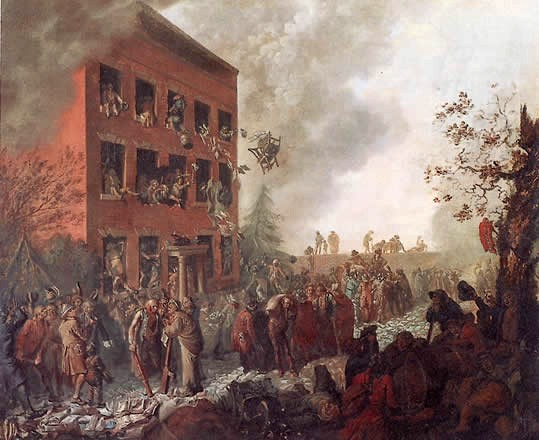
Rioters burned Priestley's home not for what he did, but for what he said about revolution.

Extremists are never bored.

Tom Junod’s remarkable piece on Fox News mogul Roger Ailes in Esquire magazine is well worth your time anyway, but for rhetoricians and students of political argument it’s pure gold–a look inside the head of the man who is largely responsible for the shape of American political discourse. It’s a long article but it pays back the effort with chestnuts like these:

What Roger Ailes has done at Fox is find a way to mainstream extremity for fun and, of course, for profit. He’s found out that people need the validating experience of extremity in the same way that he does. And he takes extreme positions and says extreme things because he needs to, because they allow him to make the choice that’s at the heart of his power.

If nothing else, Junod should be given an award of some kind for coming with a phrase that encapsulates so much about where American political discourse (and increasingly global political discourse) is today.  The “validating experience of extremity”– a notion big enough to capture both the vague anger of everyday people struggling to make the mortgage payment and the kind of madness that drove Jared Lee Loughner– is a phenomenon we should all be watching very closely.  There is perhaps no single, more important fact about the current political environment than that it is driven by this experience.

Read Full Post »

The folks over at the blog Less Wrong use the term ‘dark arts’ to refer to the usage of knowledge about heuristics and biases, fallacies, and human rationality generally in a manipulative, destructive or otherwise sinister way.  A recent post there focuses on this manner of using presuppositions:

An excellent way of doing this is to embed your desired conclusion as a presupposition to an enticing argument.  If you are debating abortion, and you wish people to believe that human and non-human life are qualitatively different, begin by saying, “We all agree that killing humans is immoral.  So when does human life begin?”  People will be so eager to jump into the debate about whether a life becomes “human” at conception, the second trimester, or at birth (I myself favor “on moving out of the house”), they won’t notice that they agreed to the embedded presupposition that the problem should be phrased as a binary category membership problem, rather than as one of tradeoffs or utility calculations.

This sort of thing is nothing new to argumentation theorists, of course, but the explicit labeling of such maneuvers as “dark arts” may well be.  Argumentation theorists, rhetoricians, and informal logicians often think in terms of fallacies, mistakes or blunders instead, usually meaning to impute no moral status to such things.  In the main I think this is wise, as highly developed skill at arguing and avoiding fallacies and other such mistakes is rare. That being the case it would be deeply problematic to assume nefarious motives lying behind every fallacy.

(more…)

Read Full Post »

Third International Conference on Argumentation, Rhetoric, Debate and the Pedagogy of Empowerment

THINKING AND SPEAKING A BETTER WORLD

October 22, 23, 24, 2010, Faculty of Arts, University of Maribor, Slovenia

The Department of Philosophy, Faculty of Arts, University of Maribor, Slovenia (Oddelek za filozofijo, Filozofska fakulteta, Univerza v Mariboru, Slovenija), World Debate Institute (University of Vermont USA) and ZIP (Za in proti, zavod za kulturo dialoga/Pro et contra Institute for culture of dialogue Slovenia) invite all scholars and practitioners of argumentation, rhetoric, debate, and educators using deliberative education methodologies to the Third International Conference on Argumentation, Rhetoric, Debate and the Pedagogy of Empowerment — THINKING AND SPEAKING A BETTER WORLD.

The conference will welcome scholars and educators from diverse fields for vigorous dialogue and exchange.  This conference will unite scholars of argumentation and rhetoric, teachers, and organizers of local, national and international debating networks to discuss critical thinking and advocacy discourse through pedagogy.  We intend for the conference to welcome all who are involved in public discussions and debates about different issues.

(more…)

Read Full Post »

An interesting distinction is made by Andrew Cline in this recent post on his rhetoric and journalism blog, Rhetorica, between “punditry” and “opinion journalism”.

According to Cline, opinion journalism is reporting informed by or explicitly written from a particular political perspective.  It includes acting as a “custodian of fact” and observing a “discipline of verification”.  The offers this description of that discipline via a link to an older post:

A discipline of verification should be basic to any practice that we would understand as journalism. Practicing such a discipline means that journalists must be custodians of fact, i.e. journalists should get to the bottom of civic disputes by gathering and verifying facts rather than simply allowing interested sources to spout off. Journalists should protect the facts from those who would spin them, ignore them, or distort them. When journalists don’t practice this discipline, they are guilty of spinning, ignoring, and distorting, often in the name of fairness and balance.

As to being a custodian of fact, Cline has this to say in another older post on Rhetorica:

What I’m getting at here is this: facts are not necessarily easy things to nail down unless we’re measuring (and even then we can run into problems). […] There can be no argument over facts in themselves. We argue about how facts are measured and what facts mean. And we argue about assertions of fact until such assertions are established as fact. Reporters should consider the statements by sources as assertions of fact until such time as the reporter can establish them as facts. The news organization, then, should not publish unverified assertions without disclaimers or qualifiers.

In contrast to opinion journalism, according to Cline, punditry is simply about “winning politically” and does not include the imperatives to be a custodian of fact or to follow a discipline of verification.

(more…)

Read Full Post »

It is common knowledge that political extremism is on the rise in the U.S..  I was listening to a radio broadcast in this series this morning, and the question came up of whether or not talk radio and television personalities who play to political extremes are morally responsible for the acts that some of their unbalanced listeners or viewers might do.  A case in point was the murder of George Tiller, a doctor in Kansas who Fox News’ Bill O’Reilly had several times condemned by name on the air for performing abortions. Tiller’s murderer apparently had been a fan of O’Reilly’s show.

Whether or not one thinks O’Reilly is implicated in Tiller’s death, it does seem to raise the question of whether and to what degree persons in his line of work bear responsibility for the attitudes that they model, and the overall quality of public discourse in the U.S..

My sense of things is that  people like Michael Moore and Bill O’Reilly probably don’t cause people to pick up guns unless those people are already deranged.  They do, however, signal that it is acceptable to be intolerant and abusive of people who disagree with one’s view of the world. It also encourages the polarization that is such a serious difficulty at this moment in American politics.  For these reasons it’s hard for me not to think that people who model intolerant or abusive political attitudes bear at least some responsibility for the political climate we have here.

The defense that what these folks do is all entertainment rings false to me.  I wouldn’t excuse a bully for haranguing a person in a public place on those grounds, and I don’t think the Glenn Becks of the world can get off the hook so easily either.  Even if all they wish to do is entertain, the fact is that their particular brand of entertainment has some very damaging consequences to which they ought to own up.

But if they bear responsibility, then this suggests that rhetorical activity is subject to moral constraints–perhaps not constraints on what a speech can contain in terms of ideas, but constraints on the manner in which the speech is given.  Perhaps another way to think of this is that there are moral limits to what one may do in adapting one’s speech to a particular audience.  Perhaps the notion of “pandering” captures those limits, but I’m not sure it’s the right moral category (rhetoricians, help me out).  What the talk radio people seem to me to do is something more akin, by degrees, to inciting riot. In an economic and political climate like the U.S. has right now, that seems to me to be decidedly immoral, and practically unwise.

Read Full Post »

Have a look at this interesting sequence of images by David J. Staley over at Kairos.  When you get there give it a few minutes to cycle through all the images.  This series of images is put forward as a visual argument.  Clearly it’s visual (well mostly, at any rate), but is it an argument?  If so, what is the conclusion of the argument and what are the premises?

Read Full Post »

« Newer Posts