Dan Cohen did a very nice TED talk on argumentation. If you haven’t seen it already, do check it out below!
Dan Cohen did a very nice TED talk on argumentation. If you haven’t seen it already, do check it out below!
Posted in Argumentation, Connections, Discussion | Tagged Argumentation, Dan Cohen, disagreement, TED | Leave a Comment »
WANTED: Ideas for a paper or a panel discussion or a book review session for the AILACT Group Session at the Central Division meeting of the American Philosophical Association, February 18-21, 2015, at the Ballpark Hilton, St. Louis.
This is a great way to share some ideas and test some arguments with friends. It’s always a fun social occasion too.
Topics include: critical thinking, informal logic, argumentation, their instruction, assessment, and philosophical and psychological foundations.
Please send ideas or questions by September 30 to Kevin Possin: kpossin@winona.edu
Posted in CFP, Critical Thinking, Discussion, Informal Logic, Seminar/Workshop/Program Announcements | Tagged AILACT, American Philosophical Association, Central APA 2015 | Leave a Comment »
Applications are invited for two positions in Dundee: a postdoctoral research assistant for the TSB- & EPSRC-funded project “Argument Analytics” (starting from Nov 2014); and for a PhD student for the EPSRC DTG-funded project “Recognizing Trust in Natural Language” (starting from Dec 2014). Continue Reading »
Posted in Argumentation, Computation, Job Openings | Tagged ArgLab, PhD positions in argumentation, post doc positions in argumentation | Leave a Comment »
AREW: Analogical Reasoning East & West
Heidelberg, Germany, November 24-25, 2014
AREW is a two-day workshop aimed at bringing together people working in the area of analogical reasoning, broadly speaking. The invited speakers are two people working on formal aspects of analogical reasoning, including issues of the logical representation of analogical reasoning and formal models of the same, and applications of analogical reasoning, particularly with reference to such applications in history. Further information about the workshop can be found at
https://analogicalreasoning.wordpress.com.
Posted in CFP, Computation, Logic, Rationality | Tagged analogical reasoning, formal reasoning | Leave a Comment »
26-31 July 2015,
Antwerp, Belgium
Pragmatic insights for analysing multimodal argumentative discourse
Panel organizers:
Assimakis Tseronis, University of Amsterdam
Chiara Pollaroli, Università della Svizzera italiana
Charles Forceville, University of Amsterdam
In the last two decades or so, scholars from discourse analysis, cognitive linguistics, as well as pragmatics and argumentation studies have started paying attention to the non-verbal modes that interact with the verbal in a variety of media and communicative genres. Within multimodal discourse analysis, each mode is studied as realising part of the information communicated and their interaction as contributing to meaning-making processes. In most of the studies within multimodal analysis, however, the focus is more on the image-internal aspects than on the interaction between the image and the viewer and the properties of the context that play a role in the interpretation process.
Cognitive approaches to visual communication, by contrast, have focused on the interpretation Continue Reading »
Posted in CFP, Communication, Connections | Tagged International Pragmatics Association, IrPA, multi-modal argument, visual argument | 1 Comment »
23-26 September, 2015
Diego Portales Univeristy,
Santiago, Chile
Conference Website: http://www.cear-lact.udp.cl/index.htm
The Fourth International Conference on Argumentation, Psychology of Reasoning and Critical Thinking is a new academic effort of our Centre to continue what was started in January 2008 and continued in October 2010 and January 2013. Just as with the three first Conferences, in which we were together with researchers from Argentina, Chile, Brazil, Colombia, Mexico, Paraguay, Spain, The Netherlands, United States, and Uruguay, in this fourth Conference we are not only trying to deepen and update the production of knowledge in the fields that this conference covers, but we are also trying to contribute to a positive valuation of different proposals that develop critical thinking and promote social debate with a standard of reasonableness.
This Conference, organized by the Centre for the Study of Argumentation and Reasoning (CEAR) of the Faculty of Psychology at Diego Portales University, would like to generate tools, approaches and solutions to apply in those fields in which the uses of reason is fundamental: communication, law, education, etc. We do not have an official theoretical position, but rather we value the diversity of angles and proposals. We invite the scientific international community, which works in the topics of the Conference, to participate and share its knowledge, experience and current challenges.
Posted in Argumentation, CFP, Critical Thinking, Informal Logic, Rationality | Tagged CEAR | Leave a Comment »
2015 Call | NCA/AFA Summer Conference on Argumentation.
From the Conference website:
The key term recover is richly ambiguous. Its primary sense, according to the Oxford English Dictionary, is “to regain (something lost).” To recover argument, in this sense, might be “to bring back or restore” argumentation to human affairs, and to encourage reflection on useable traditions. Although doing so requires awareness of a past (another sense is “to remember; to recall or bring back to memory”), and although such awareness might be nostalgic, recovery can be much more complicated: Continue Reading »
Posted in Argumentation, CFP, Communication, Connections | Tagged Alta 2015 | 1 Comment »
It’s true, not much has happened here this summer. What gives?
Well, we had a little trouble. We had some illnesses, shifting burdens at work that included some heavy, important, and unforeseen tasks, and to top it all off, a flood that put most of the the RAIL home office out on the curb for the trash man. It was an eventful couple of months.
Things are looking up though. I’ve a place I can work set up again, and I’ll be clearing the backlog of announcements and ArgEvents calendar updates over the next couple of days and, with any luck, we’ll be back up and running as usual thereafter. In the meantime, please accept my apologies for late and delayed postings!
Happy Arguing!
SP
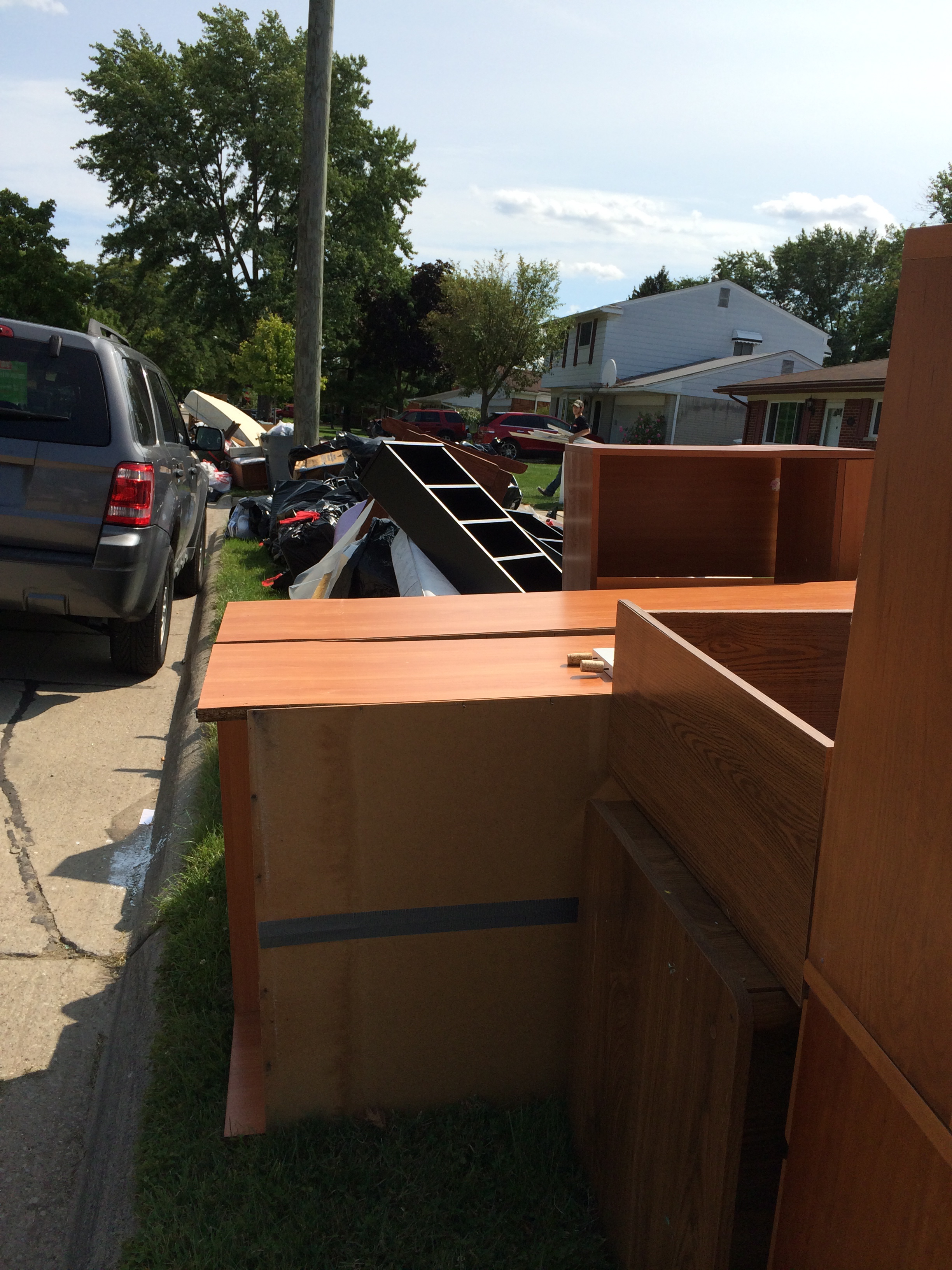
My notes are in here somewhere…or are they?
Posted in About RAIL, Announcements | Leave a Comment »
9-10 July 2014, Dundee, Scotland
http://www.arg.dundee.ac.uk/swam2014
Submissions of position statement are invited for the SICSA Workshop on Argument Mining to be held in Dundee, Scotland.
Argument mining exploits the techniques and methods of natural language processing, or more specifically – text and opinion mining, for semi-automatic and automatic recognition and extraction of structured argument data from unstructured natural language texts. Lying at the intersection of sentiment analysis and computational models of argument, it is attracting increasing attention with an ACL workshop on the topic in Baltimore (http://www.uncg.edu/cmp/ArgMining2014/) and a meeting dedicated to the topic in Warsaw (http://argdiap.pl/argdiap2014).
Posted in Argumentation, CFP, Computation, Connections, Workshops | Tagged argument mining, computational linguistics | Leave a Comment »

 RAIL
RAIL 