Feeds:
Posts
Comments

Archive for the ‘Discussion’ Category

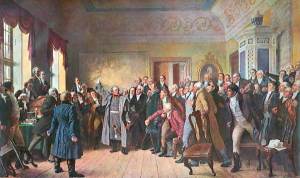
Count Yorck's speech to the East Prussian states on February 5th, 1813 in Koenigsberg", Otto Brausewetter, 1888

Last week Shaun Usher, custodian of the excellent website “Letters of Note” announced that he would close the comments section on all posts.  He writes:

All complaints should be directed towards a section of society to whom the concept of even vaguely civil discussion means nothing. …I simply cannot afford to continue mopping up after the trolls who crawl among us, itching to bring down the tone at every available opportunity.

Usher does not mince words when describing said trolls and their methodology, but I’ll let you read the best parts of the announcement for yourself.

I understand Usher’s frustration very well. Prior to writing this blog I was, for years, a moderator on a website devoted to open philosophical discussion.  This was before the days of the “new media”. There were no philosophical blogs to speak of in those days, so if you wanted to talk philosophy on the internet sites like ours were where you would go. The founder of the site and I, and the other moderators as well, worked hard to create a website that where those who knew a little something about philosophy could interact with those who were new to it, sojourning, or simply curious.  We had a great time before the site caught on.  Then the membership exploded, swollen by trolls, spammers, crackpots, political cross-posters, and bots of every description.  It became impossible to have a threaded discussion a significant portion of which wasn’t overgrown with inanity, spam, and digital graffiti (of the bathroom wall variety, not the amazing mural variety).  Those with a serious interest in the conversation petitioned and complained, and we tried harder to moderate the site.  In the end, however, it was futile.  Nothing we did could simultaneously (a) protect the discussion from its many and varied saboteurs while (b) maintaining the quality of discussion that would make a site like ours worth visiting and (c ) upholding our original vision that philosophy is neat and even non-specialists will find that out if they have a chance to discuss it in a forum with a critical mass of members who know what they’re talking about. Eventually the site crashed under the weight of the flotsam and jetsam that has generally made open-membership sites for threaded discussion like ours obsolete.  We rebuilt it twice before most of the moderators got tired of it and threw in the towel.  In the course of the years that it was truly functional, however, I learned a lot and made some friends with whom I still keep in touch. It wasn’t a bad experience by any means, but it is one that has given me a lot of food for thought. One of the things I’ve thought about quite a bit as a result of my moderating days is how our experiences online shape our perception of the public at large, and how that perception conditions and shapes (or doesn’t) our conception of democracy.

(more…)

Read Full Post »

I’m pleased to announce here on RAIL that the journal Cogency has allowed open access to it’s first four issues. I’m not sure if they plan to continue this policy, as, for instance, Informal Logic does, but for now it’s a great opportunity to check out what is already a diverse and interesting array of articles by many of the leading scholars in our field. (How they let an article of mine slip into the mix is anyone’s guess!)

Do check it out!

Read Full Post »

An interesting find for me this week was the online philosophy journal American Dialectic.  Unlike most online journals AD doesn’t aspire simply to be the online version of a print journal. It aims, instead, to encourage thoughtful discussion by publishing focused responses to the articles and (ostensibly at least)  having authors respond to readers’ questions and comments about their articles.  Hence this, from the journal’s “About Us” page:

American Dialectic is an online journal committed to enriching scholarly publication, discourse, and intellectual development in Philosophy and related fields.  As an organization, American Dialectic is devoted to publishing intellectually excellent articles and to promoting the dialectical development of ideas among a broad community of readers.  This is accomplished by combining the best aspects of a traditional publication with the best aspects of a scholarly conference: lead articles are published on our website and then are followed throughout the publication cycle by edited responses that are written and submitted by our readers.  Through this unique publishing mechanism, American Dialectic aims to foster the continued intellectual development of contributors, respondents, and readers alike. […] Readers are encouraged to genuinely engage with the articles by asking targeted questions and formulating insightful responses.  Substantial questions and responses, junior submissions themselves, are then actively published following the lead article.  The lead authors, respondents and readers can then, as a community, identify important points, clarify issues, resolve problems, and ultimately find common ground by building toward a more complete philosophic understanding.

It’s a nice idea, and one that hearkens back to the way philosophy journals operated until the explosion of PhDs in the discipline in the 1970s and 80s.  Comments and discussion notes are still formally welcomed by many journals, but the reality is that they are seldom published and even less frequently answered.  This means that there isn’t much incentive to write such things even though they do a great service to the person trying to work the bugs out of his or her ideas.  The community of those interested in the ideas of a particular article or writer are, as a result, also deprived of the chance to see how the ideas in question fare in thoughtful, critical discussion. This, to my mind, is a real loss. (more…)

Read Full Post »

"Homme assis" by Roger-Noël-François de La Fresnaye, c.1914

In a recent blog post provocatively titled “Kurt Vonnegut turns Cinderella into an Equation” Robert Krulwich (co-host of the excellent WNYC series Radiolab) uses a wonderful pair of cartoons to suggest that if humans are creatures who thrive on pattern, then scientists and mathematicians are compulsive pattern finders,  “pattern addicts” as it were.  Logicians and students of argument, I think, fairly belong in this category as well. Some of us talk about logical form and explain it in terms of complicated relationships between abstract symbols and letters. Or we classify arguments by scheme and develop equally schematic lists of questions with which to test their merits. The dialectically inclined among us give us patterns of argumentation between two or more arguers.  We create argument diagrams, relevance cubes, maps of controversies and many more things like them besides. We’re pattern people. There’s no doubt about it.

Interestingly, Krulwich closes his post by suggesting that even more than than scientists and mathematicians (and perhaps logicians and argumentation scholars too?) artists and storytellers may be even more pattern-aware. As exhibit the first he offers this short (and altogether too good not to reproduce) video of the legendary Kurt Vonnegut:

Let us begin with the obvious: we don’t need Vonnegut to tell us that stories have patterns too (though of course his way of telling us is very entertaining and we’re very lucky to have it). Clearly they’re there. The deeper issue has to do with the nature and significance of such patterns. How do we interpret them? How do we reason about them? How do we reason with them?

(more…)

Read Full Post »

Apollo and the Muses by Hans Holbein the Younger, 1533

The world of those who study argument and who study reason and rationality is abuzz with talk of the provocative research of Hugo Mercier and Dan Sperber. Anyone who was at last week’s OSSA conference heard their names in practically every other conversation or presentation. For my own part I’m not sure quite what to make of their work.  On the one hand it’s exciting to see argument and reason brought together in empirical research, and I’m well on record as being very friendly to the notion that argument has a very deeply rooted functionality for human beings at both the collective and individual levels. On the other hand, I’m not sure that there aren’t grave problems lurking within. For one, Mercier and Sperber seem at times to work from the assumption that ‘argument’ means ‘deductive argument’ and if this is so, I’m not at all sure that it is wise.  The body of work on analogy alone would give me pause regarding the prospects of such a view, to say nothing of the work of the informal logic movement in the last 30 years.  There are other things that trouble me, but as I’m still doing research in this general idea I’ll try to save myself what might turn out to be a super-sized helping of crow and leave the reader to their own devices where Messrs. Mercier and Sperber are concerned.

At any rate there’s no denying it’s relevance to the world of argumentation theory.  In that vein this video interview with Hugo Mercier is one that I expect will be of interest to many.  The interview is located at the web journal* Edge, itself worth a look to those with an interest in interdisciplinary intellectual discourse.

*(All apologies to those of you who thought that by ‘Edge’ I was referring to an Irish fellow–though I confess I probably would have watched that interview with interest too.)

Read Full Post »

OSSA 2011 is now officially in the bag.  It was a good week. With such a high volume of papers presented it’s possible to follow many trajectories, but these were my highlights:

The Ambassador Bridge

  • Attending a pre-conference workshop on normative pragmatics with Jean Goodwin and Beth Innocenti. Jean and Beth did a fantastic job explaining their views and those of Fred Kauffeld, with whom I was also fortunate enough to chat with at length. Even having known something of these views before, I left considerably enriched for the experience, and convinced that normative pragmatics is a research program that deserves a lot more investigation and development.
  • Discourse analyst Karen Tracy’s keynote address on reasonable hostility in public hearings was also rich with ideas that I intend to think a lot more about in the coming weeks–especially her conception of how issues move through phases of being unarguable (unreflectively taken as settled), arguable (manifestly unsettled or controversial) and then unarguable again (settled sufficiently for the public discussion to move on).  This is not to say that the other keynotes were not also worthwhile–they were. Paul Thagard’s effort to bring a neuropsychological viewpoint to the discussion over the nature of critical thinking was timely, and David Hitchcock’s presentation of his work on inference claims was as interesting and challenging as those who know his work would expect it to be. (You can read the abstracts of the keynotes here.)
  • Having the chance both to attend Maurice Finocchiaro’s session on deep disagreement and to chat with him about it afterwards was illuminating.  As readers of this blog will know, deep disagreement is one of my areas of interest within argumentation theory. Finocchiaro’s work, which will be part of a forthcoming book on meta-argumentation, moves the discussion of deep disagreement forward in what I think are all the right ways.  I’m very glad he’s taken the problem on in the way that he has.
  • Of course I have to thank the wonderful audience that attended my presentation on the history of conductive argument and reflective equilibrium as well. We had an excellent discussion from which I learned much that I will bear in mind as I carry forward my work on this and other projects.

Finally, no discussion of an OSSA conference would be complete without mention of the enormous camaraderie and good will that animates these events.  Coming away from this iteration of OSSA I am reminded of my initial impression that the argumentation community models what I think are scholarly ideals of diversity of approach, internationality and interdisciplinarity.  Of course, we have our divisions and competitive moments just like any other body of scholars.  This is only natural among diverse people who care deeply about what they study and who struggle to get it right.  What is impressive about argumentation theory is that these divisions enliven the discussions rather than hamper them.  In many ways, these gatherings are as much gatherings of friends as they are academic gatherings. Thus, though I won’t try the reader’s patience with a long list of names, I will close this entry by saying how glad I am to have had the chance to catch up with so many old friends, and to have made so many new ones. All in all, it was a week well spent. I look forward to the next one.

Read Full Post »

The Ambassador Bridge, via Wikimedia Commons. Original by Mike Russell, CC 3.0 S-A

As many in the argumentation studies community know next week is OSSA 9, one of the bigger events on our calendars.  The conference theme this go around is “Argumentation, Cognition and Community”.  Having had a look at the schedule I think this promises to be an interesting conference. Many leading scholars in argumentation, informal logic, rhetoric, and normative pragmatics will be there presenting and responding to papers.  There is also a good range of strong papers by up and coming scholars as well.  This is one to look forward to, if you’ll be coming.

All the pertinent information for OSSA, including .pdf downloads of the schedule and abstracts among other things, can be accessed here.

Unfortunately, as we all know, not everyone who would like to attend can attend.  These are tough times and many of us find ourselves at institutions who can’t always support travel to events like these as often or to the degree that they would wish. For those who won’t be coming but want to follow along, I thought I might propose a conference back-channel on Twitter with the hashtag #OSSA2011.  Those of us who have Twitter accounts and will be there could post about discussions, sessions, workshops, and everything else OSSA between sessions or whenever else we have the chance.  That way those who cannot come can follow along. An added benefit is that those of us who are there will be able get to know each other a little better and to coordinate a little easier when it comes to dinner plans, taxi rides, etc.. (To get a better idea of how it works, you might check out this post from the innovative and consistently helpful ProfHacker blog on the Chronicle of Higher Ed website.)

If you’re interested, let me know!  You can comment here or post to Twitter including “#OSSA2011” somewhere in your tweet.

Read Full Post »

"carrier pigeons" with messages attached. Harper's New Monthly Magazine, No. 275, April, 1873. via Wikimedia Commons

Thankfully, messaging technology is now far more advanced than this.

Recently I had the pleasure to participate in an online argumentation colloquium. We used Skype for the actual video interaction and Dropbox to share files before, during, and after the event. Frank Zenker (also an author here) was the driving force behind the project. Jean Goodwin, Bart Verheij, Frank, and myself all did presentations or read papers which we then discussed. It is safe to say that all participants unanimously regarded the event as a success.  You can read Frank’s excellent summary of the experience and what we learned by doing it in Informal Logic here or by downloading the pdf (containing screen-shots of the event) from his website here.

As those with a scholarly interest in argumentation know, our peers and friends in this field are scattered across the entire planet. Other areas of research can say the same thing of course, but in many cases the number of folks working in those areas is such that getting together doesn’t necessarily require extensive international travel.  Often, unless a scholar in argumentation studies has the good fortune to be located near a university-sponsored institute or grad program like the ones at the University of Windsor, UVA or Lugano, one has to wait until a conference to see one’s colleagues and have the chance to discuss works in progress.  Put that together with the increasing financial constraints most of us find ourselves under, with the environmental impacts of all those plane, train, and taxi rides, and with the increasing quality, availability, and ease of use of the requisite software, and the idea of online collaboration of the sort we tried starts to make more and more sense.

It seems clear that online colloquia couldn’t take the place of large scale gatherings like ISSA, OSSA, the RSA or ArgMAS. Still, they’re a great way to stay in contact and work collaboratively to move our research programs forward.  At least, that’s what we think.  What do you think? Would you be open to participating in or hosting events of this kind? Perhaps you’ve already tried this sort of thing. If so, how did it go for you?

Read Full Post »

This lovely little RSA animation featuring linguist Sephen Pinker should be interesting for theorists of argument on multiple levels.  Such explanations as Pinker’s bear directly on how we take on enthymemes, how we think about dialectical guidelines, how we think about the practice of argumentation in general, etc.  I could go on, but instead I’ll let the charming video do the work*:

Direct Link: YouTube – RSA Animate – Language as a Window into Human Nature.

*Those who have heard me prattle on about David Lewis’s Convention in the recent past are hereby excused, but should watch anyway because of how cool these RSA animate thingies are. 🙂

Read Full Post »

Anna Elizabeth Dickinson (1842-1932), the first woman to address the US Congress was by all accounts "a gifted orator".

Many in the field of rhetoric, I’ll wager, are happy to see an article about their discipline at all in a major newspaper like the Guardian.  Being a philosopher myself I sympathize with the sort of small-town-ish “Hey! They’re talking about US!!” feeling engendered by articles like Mary Beard’s What makes a great speech?

The article itself, however, is rather a letdown in terms of what it communicates to the reader about rhetoric.

Let me begin in fairness by noting that Mary Beard is a well-known classicist in the UK.  Thus it is not surprising that her treatment of rhetoric here focuses primarily on sources and examples drawn from Greco-Roman antiquity.  Be this as it may, she speaks in a general voice here about rhetoric and so her discussion is disturbingly incomplete. Rather than showing rhetoric as the very active and modern discipline that it is, her focus on the ancients gives the impression that the study of rhetoric ended with Cicero. She makes no mention at all of any figures in the history of rhetoric between antiquity and the present day. Not even foundational figures of contemporary rhetoric like Perelman and Olbrechts-Tyteca, get a mention, to say nothing of figures lesser known outside rhetoric but equally if not more important within it like Burke, Richards, Toulmin, or Henry Johnstone Jr..  Though to her credit she avoids rehashing the standard Platonist objections to rhetoric, Beard’s presentation is rendered somewhat shallow by her lack of modern sources.  (more…)

Read Full Post »

« Newer Posts - Older Posts »