This international workshop on complex networks (CompleNet 2012) aims at bringing together researchers and practitioners working on areas related to complex networks. In the past two decades we have been witnessing an exponential increase on the number of publications in this field. From biological systems to computer science, from economic to social systems, complex networks are becoming pervasive in many fields of science. It is this interdisciplinary nature of complex networks that this workshop aims at addressing.
Authors are encouraged to submit previously unpublished papers/abstracts on their research in complex networks. Both theoretical and applied papers are of interest. Specific topics of interest are (but not limited to): (more…)
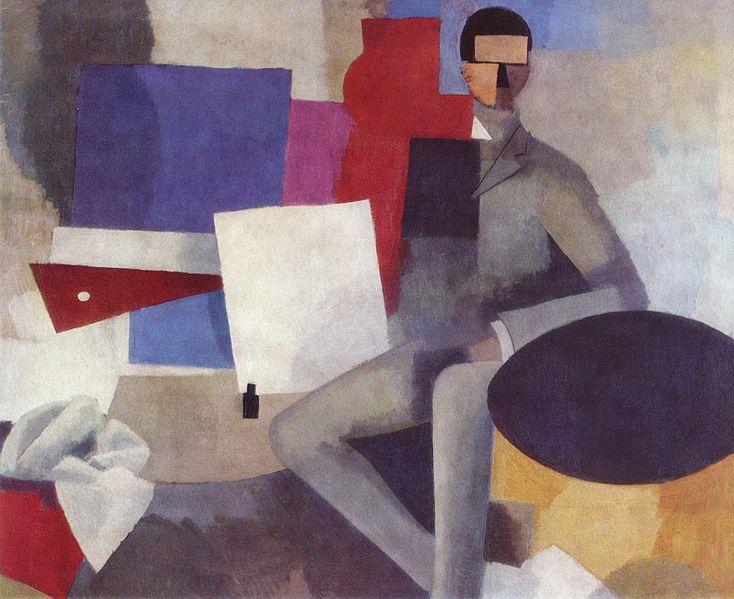
"Homme assis" by Roger-Noël-François de La Fresnaye, c.1914
In a recent blog post provocatively titled “Kurt Vonnegut turns Cinderella into an Equation” Robert Krulwich (co-host of the excellent WNYC series Radiolab) uses a wonderful pair of cartoons to suggest that if humans are creatures who thrive on pattern, then scientists and mathematicians are compulsive pattern finders, “pattern addicts” as it were. Logicians and students of argument, I think, fairly belong in this category as well. Some of us talk about logical form and explain it in terms of complicated relationships between abstract symbols and letters. Or we classify arguments by scheme and develop equally schematic lists of questions with which to test their merits. The dialectically inclined among us give us patterns of argumentation between two or more arguers. We create argument diagrams, relevance cubes, maps of controversies and many more things like them besides. We’re pattern people. There’s no doubt about it.
Interestingly, Krulwich closes his post by suggesting that even more than than scientists and mathematicians (and perhaps logicians and argumentation scholars too?) artists and storytellers may be even more pattern-aware. As exhibit the first he offers this short (and altogether too good not to reproduce) video of the legendary Kurt Vonnegut:
Let us begin with the obvious: we don’t need Vonnegut to tell us that stories have patterns too (though of course his way of telling us is very entertaining and we’re very lucky to have it). Clearly they’re there. The deeper issue has to do with the nature and significance of such patterns. How do we interpret them? How do we reason about them? How do we reason with them?
The series of CMNA workshops, since its inception in 2001, has been acting to nurture and provide succor to the ever growing community working in “Argument and Computation”. AI has witnessed a prodigious growth in uses of argumentation throughout many of its subdisciplines: agent system negotiation protocols that demonstrate higher levels of sophistication and robustness; argumentation-based models of evidential relations; groupwork tools that use argument to structure interaction and debate; computer-based learning tools that exploit monological and dialogical argument structures in designing pedagogic environments; decision support systems that build upon argumentation theoretic models of deliberation to better integrate with human reasoning
The CMNA workshop series has seen a notable growth in submissions, and forms a complement to more recent series or events, like the ArgMAS series, begun in 2004, and the nascent COMMA series, which held its first meeting in 2006. CMNA keeps a broader, interdisciplinary emphasis on natural (real) arguments and the computational tools and techniques for modeling, manipulating and exploiting them. (more…)
With his seminal paper “deontic logic” published in Mind in 1951, Von Wright launched the area of deontic logic. It is the field of logic that is concerned with obligation, permission, and related concepts.
We invite papers concerned with the logical study of normative reasoning, including formal systems of deontic logic, defeasible normative reasoning, the logic of action, and other related areas of logic, and the formal analysis of normative concepts and normative systems. (more…)
Recent years have witnessed a rapid growth of interest in formal models of argumentation and their application in diverse sub-fields and domains of application of AI. Argumentation thus shows great promise as a theoretically-grounded tool for a wide range of applications. This workshop aims at contributing to the realisation of this promise, by promoting and fostering uptake of argumentation as a viable AI paradigm with wide ranging application, and providing a forum for further development of ideas and the initiation of new and innovative collaborations. TAFA therefore encourages submission of papers on formal theoretical models of argumentation and application of such models in (sub-fields of) AI, and evaluation of models, both theoretical (in terms of formal properties) and practical (in concretely developed applications). We also particularly encourage work on theories and applications developed through inter-disciplinary collaborations. (more…)

 RAIL
RAIL 