All complaints should be directed towards a section of society to whom the concept of even vaguely civil discussion means nothing. …I simply cannot afford to continue mopping up after the trolls who crawl among us, itching to bring down the tone at every available opportunity.
Usher does not mince words when describing said trolls and their methodology, but I’ll let you read the best parts of the announcement for yourself.
I understand Usher’s frustration very well. Prior to writing this blog I was, for years, a moderator on a website devoted to open philosophical discussion. This was before the days of the “new media”. There were no philosophical blogs to speak of in those days, so if you wanted to talk philosophy on the internet sites like ours were where you would go. The founder of the site and I, and the other moderators as well, worked hard to create a website that where those who knew a little something about philosophy could interact with those who were new to it, sojourning, or simply curious. We had a great time before the site caught on. Then the membership exploded, swollen by trolls, spammers, crackpots, political cross-posters, and bots of every description. It became impossible to have a threaded discussion a significant portion of which wasn’t overgrown with inanity, spam, and digital graffiti (of the bathroom wall variety, not the amazing mural variety). Those with a serious interest in the conversation petitioned and complained, and we tried harder to moderate the site. In the end, however, it was futile. Nothing we did could simultaneously (a) protect the discussion from its many and varied saboteurs while (b) maintaining the quality of discussion that would make a site like ours worth visiting and (c ) upholding our original vision that philosophy is neat and even non-specialists will find that out if they have a chance to discuss it in a forum with a critical mass of members who know what they’re talking about. Eventually the site crashed under the weight of the flotsam and jetsam that has generally made open-membership sites for threaded discussion like ours obsolete. We rebuilt it twice before most of the moderators got tired of it and threw in the towel. In the course of the years that it was truly functional, however, I learned a lot and made some friends with whom I still keep in touch. It wasn’t a bad experience by any means, but it is one that has given me a lot of food for thought. One of the things I’ve thought about quite a bit as a result of my moderating days is how our experiences online shape our perception of the public at large, and how that perception conditions and shapes (or doesn’t) our conception of democracy.
CALL FOR PAPERS: AILACT @ the APA Eastern Division, December 28-30, 2011, Washington, DC
Deadline: July 31
We are now accepting proposals on any relevant topic for the Association for Informal Logic and Critical Thinking (AILACT) session to be held in conjunction with this year’s Eastern Division meetings of the APA. Papers, papers-with-commentators, author-meets-critics, and panel discussions are all welcome. Send proposals or abstracts to dhcohen@colby.edu by July 31.
I’m pleased to announce here on RAIL that the journal Cogency has allowed open access to it’s first four issues. I’m not sure if they plan to continue this policy, as, for instance, Informal Logic does, but for now it’s a great opportunity to check out what is already a diverse and interesting array of articles by many of the leading scholars in our field. (How they let an article of mine slip into the mix is anyone’s guess!)
Linked to the Department of Arts and Literature of Universidade Estadual de Santa Cruz, the Journal EID&A – Electronic Journal of Integrated Studies in Discourse and Argumentation – arises from a mission to contribute to the dissemination of studies located in the interface between Discourse Analysis and Argumentation. Thus, papers submitted to this Scientific Committee should be taken on the perspective of studies that comprise the argumentation in the process of constructing meaning in discourse and in the utterance situation. The goal is to promote discussion of theoretical objects or analysis of these discursive practices in society.
Call for Papers
The first issue EID&A will gather papers which focus precisely on the essence, problems and prospects from the interface between Discourse Analysis and Argumentation.
The journal EID&A – Electronic Journal of Integrated Studies in Discourse and Argumentation – invites researchers to contribute with papers focused on the discussion about the nature, problems and prospects of the interface between the Discourse Analysis and the Argumentation.
The Journal EID&A is going to publish papers, translations and reviews. For more details, authors must consult the rules for submissions of papers, available on the website www.uesc.br/revistas/eidea/english.
The deadline for submission of papers will end on July 1st, 2011. The first edition of the EID&A is awaited to September 2011.
An interesting find for me this week was the online philosophy journal American Dialectic. Unlike most online journals AD doesn’t aspire simply to be the online version of a print journal. It aims, instead, to encourage thoughtful discussion by publishing focused responses to the articles and (ostensibly at least) having authors respond to readers’ questions and comments about their articles. Hence this, from the journal’s “About Us” page:
American Dialectic is an online journal committed to enriching scholarly publication, discourse, and intellectual development in Philosophy and related fields. As an organization, American Dialectic is devoted to publishing intellectually excellent articles and to promoting the dialectical development of ideas among a broad community of readers. This is accomplished by combining the best aspects of a traditional publication with the best aspects of a scholarly conference: lead articles are published on our website and then are followed throughout the publication cycle by edited responses that are written and submitted by our readers. Through this unique publishing mechanism, American Dialectic aims to foster the continued intellectual development of contributors, respondents, and readers alike. […] Readers are encouraged to genuinely engage with the articles by asking targeted questions and formulating insightful responses. Substantial questions and responses, junior submissions themselves, are then actively published following the lead article. The lead authors, respondents and readers can then, as a community, identify important points, clarify issues, resolve problems, and ultimately find common ground by building toward a more complete philosophic understanding.
It’s a nice idea, and one that hearkens back to the way philosophy journals operated until the explosion of PhDs in the discipline in the 1970s and 80s. Comments and discussion notes are still formally welcomed by many journals, but the reality is that they are seldom published and even less frequently answered. This means that there isn’t much incentive to write such things even though they do a great service to the person trying to work the bugs out of his or her ideas. The community of those interested in the ideas of a particular article or writer are, as a result, also deprived of the chance to see how the ideas in question fare in thoughtful, critical discussion. This, to my mind, is a real loss. Continue Reading »
The JURIX conference has been running annually for over 20 years and provides an international forum for both academics and practitioners in the field of legal informatics to meet and share their research and ideas to advance the field of legal knowledge systems. The 24th edition of JURIX will be hosted by the University of Vienna. We invite submission of original papers on the advanced management of legal information and knowledge, covering foundations, methods, tools, systems and applications for the following (non-exhaustive) list of topics:
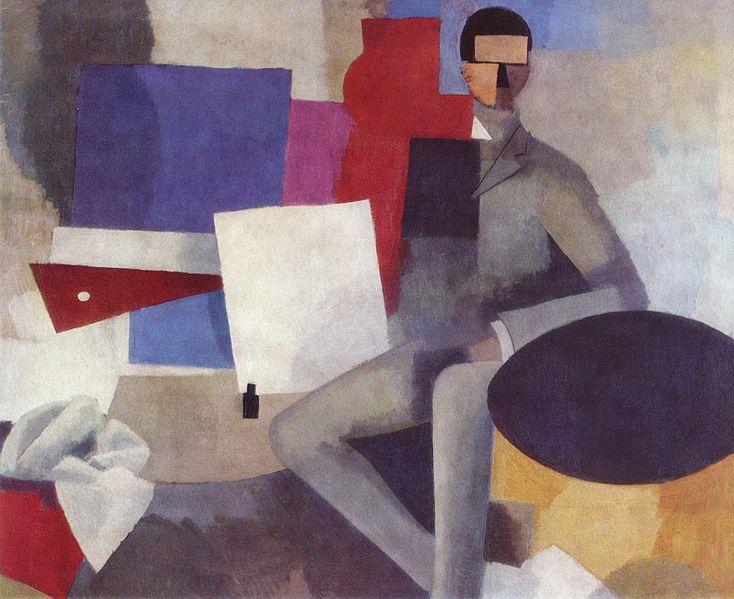
"Homme assis" by Roger-Noël-François de La Fresnaye, c.1914
In a recent blog post provocatively titled “Kurt Vonnegut turns Cinderella into an Equation” Robert Krulwich (co-host of the excellent WNYC series Radiolab) uses a wonderful pair of cartoons to suggest that if humans are creatures who thrive on pattern, then scientists and mathematicians are compulsive pattern finders, “pattern addicts” as it were. Logicians and students of argument, I think, fairly belong in this category as well. Some of us talk about logical form and explain it in terms of complicated relationships between abstract symbols and letters. Or we classify arguments by scheme and develop equally schematic lists of questions with which to test their merits. The dialectically inclined among us give us patterns of argumentation between two or more arguers. We create argument diagrams, relevance cubes, maps of controversies and many more things like them besides. We’re pattern people. There’s no doubt about it.
Interestingly, Krulwich closes his post by suggesting that even more than than scientists and mathematicians (and perhaps logicians and argumentation scholars too?) artists and storytellers may be even more pattern-aware. As exhibit the first he offers this short (and altogether too good not to reproduce) video of the legendary Kurt Vonnegut:
Let us begin with the obvious: we don’t need Vonnegut to tell us that stories have patterns too (though of course his way of telling us is very entertaining and we’re very lucky to have it). Clearly they’re there. The deeper issue has to do with the nature and significance of such patterns. How do we interpret them? How do we reason about them? How do we reason with them?
In recent posts here on RAIL I’ve been upfront about my tendency to like Mercier and Sperber’s work. Critical discussion of it, however, is still valuable and this short article in Scientific American by John Horgan is an accessible, if somewhat ambivalent gesture in that direction.
Harman announced on Twitter today that the full text of his 1987 book on reasoning, Change in View had been made available for free download at his website. Readers of RAIL will, I think, find Harman’s book interesting if they’ve not yet been exposed to it. Chapter 2 in particular will be of interest to many, as Harman there argues that “logic is not of any special relevance” to the theory of reasoning. Chapter 7, on explanatory coherence is also likely to arouse the interest of many readers. Apart from Chapters two and seven there are treatments of belief revision, implicit commitments, and reason and obligation that are likely to be of interest as well. Harman’s characteristically thorough and challenging analysis are evident throughout Change in View. The book can be downloaded in sections or as one file. Either way, it’s a great opportunity to get a hold of a fascinating book by one of the most influential American philosophers of the last 40 years.
We are increasingly dependent on advice from experts in making decisions in our personal, professional, and civic lives. But as our dependence on experts has grown, new media have broken down the institutional barriers between the technical, personal and civic realms, and we are inundated with purported science from all sides. Many share a sense that science has lost its “rightful place” in our deliberations. Grappling with this cluster of problems will require collaboration across disciplines: among rhetorical and communication theorists studying the practices and norms of public discourse, philosophers interested in the informal logic of everyday reasoning and in the theory of deliberative democracy, and science studies scholars examining the intersections between the social worlds of scientists and citizens. For this conference, we invite work on expertise in policy controversies from across the disciplines focused on argumentation, reasoning, communication and deliberation.



 RAIL
RAIL 