Feeds:
Posts
Comments

Archive for the ‘Informal Logic’ Category

OSSA 2011 is now officially in the bag.  It was a good week. With such a high volume of papers presented it’s possible to follow many trajectories, but these were my highlights:

The Ambassador Bridge

  • Attending a pre-conference workshop on normative pragmatics with Jean Goodwin and Beth Innocenti. Jean and Beth did a fantastic job explaining their views and those of Fred Kauffeld, with whom I was also fortunate enough to chat with at length. Even having known something of these views before, I left considerably enriched for the experience, and convinced that normative pragmatics is a research program that deserves a lot more investigation and development.
  • Discourse analyst Karen Tracy’s keynote address on reasonable hostility in public hearings was also rich with ideas that I intend to think a lot more about in the coming weeks–especially her conception of how issues move through phases of being unarguable (unreflectively taken as settled), arguable (manifestly unsettled or controversial) and then unarguable again (settled sufficiently for the public discussion to move on).  This is not to say that the other keynotes were not also worthwhile–they were. Paul Thagard’s effort to bring a neuropsychological viewpoint to the discussion over the nature of critical thinking was timely, and David Hitchcock’s presentation of his work on inference claims was as interesting and challenging as those who know his work would expect it to be. (You can read the abstracts of the keynotes here.)
  • Having the chance both to attend Maurice Finocchiaro’s session on deep disagreement and to chat with him about it afterwards was illuminating.  As readers of this blog will know, deep disagreement is one of my areas of interest within argumentation theory. Finocchiaro’s work, which will be part of a forthcoming book on meta-argumentation, moves the discussion of deep disagreement forward in what I think are all the right ways.  I’m very glad he’s taken the problem on in the way that he has.
  • Of course I have to thank the wonderful audience that attended my presentation on the history of conductive argument and reflective equilibrium as well. We had an excellent discussion from which I learned much that I will bear in mind as I carry forward my work on this and other projects.

Finally, no discussion of an OSSA conference would be complete without mention of the enormous camaraderie and good will that animates these events.  Coming away from this iteration of OSSA I am reminded of my initial impression that the argumentation community models what I think are scholarly ideals of diversity of approach, internationality and interdisciplinarity.  Of course, we have our divisions and competitive moments just like any other body of scholars.  This is only natural among diverse people who care deeply about what they study and who struggle to get it right.  What is impressive about argumentation theory is that these divisions enliven the discussions rather than hamper them.  In many ways, these gatherings are as much gatherings of friends as they are academic gatherings. Thus, though I won’t try the reader’s patience with a long list of names, I will close this entry by saying how glad I am to have had the chance to catch up with so many old friends, and to have made so many new ones. All in all, it was a week well spent. I look forward to the next one.

Read Full Post »

Informal Logic, vol. 31, no. 1

As part of the mission of RAIL is to keep readers informed of new publications, journals, and articles of interest, I’ve arranged with the editors to post announcements here when new issues of Informal Logic become available.  If you’d like to have your informal logic/argumentation-themed journal, or special issue similarly featured here by all means please drop me a line and let me know!

Click here or on the image above to reach the current issue of Informal Logic.  If you see something you find interesting or want to discuss in this issue, why not start the conversation by commenting on it below?

Read Full Post »

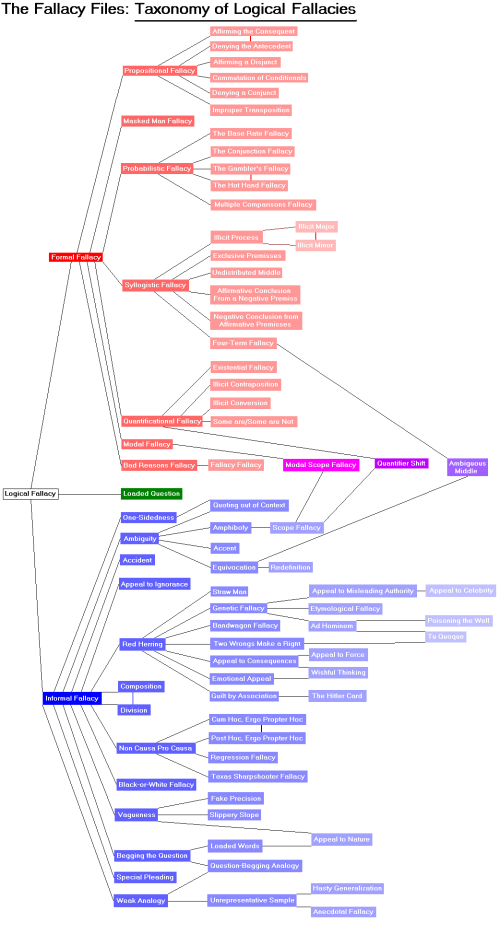
Here’s a lovely graphical representation of the family of fallacies via The Fallacy Files. (Note: I found out about this infographic first via the Philosorapters blog, which gives advice on job hunting mostly but also occasionally on teaching philosophy.) I think many readers of RAIL will find this way of cutting the cake rather interesting, as the classification of some fallacies is…let’s say novel.  Others represented here are altogether new to me (e.g. the “Texas Sharpshooter”).

Whatever one makes of it, you have to tip your cap to the work that no doubt went into putting this concept map together. I’d love to see some alternatives.  Anyone out there up for it?

I'm a sucker for a nice infographic!

Read Full Post »


Now, here’s the thing.  I like Michael Sandel. I really do. (I even met him once, though I really, really doubt he would remember.) He’s done a lot to advance the cause of political communitarianism–a position that I respect immensely though I do not share it–and I generally regard him as a decent political philosopher.

Perhaps that’s why I have such a hard time sharing his optimism that the world’s democratic processes can be positively reformed if we simply replicate the Socratic teaching model he uses with a roomful of highly intelligent professionals in this TED session (or his classes at Harvard) with audiences throughout the world. It’s an idea that doesn’t live up to the rest of Sandel’s body of work.

That said, it’s not as though he doesn’t have a point. In a sense he’s right. We (in the US) generally have lost the art of public debate.  In my view that’s got a lot to do with our media culture, the state of our educational institutions, our particular political landscape at this point in history, and a host of other factors. I’m just not sure that the cure for what ails us is a re-instating of Aristotelian etiological vocabulary. Don’t get me wrong–I love Aristotle’s ideas too; rather more than Sandel’s in fact– but there’s something a bit too easy about Sandel’s approach to political deliberation here. The missing elements of this talk (and here I find myself thinking back to Jim Freeman’s ISSA keynote from last summer) only remind me, yet again, of how much “mainstream” moral and political philosophy could gain through an acquaintance with argumentation theory.

But maybe that’s just me. Perhaps I’m missing something in this talk, or I simply need a hug today or something.

Read Full Post »

Mulling over deep disagreement (again) I came across this nice little piece by David Suissa at the Huffington Post from a little over a year ago.  In it he talks about the traditional Jewish narrative of the houses of Shammai and Hillel, who differed over how to interpret the Jewish law (Shammai insisted on strict adherence, while Hillel counseled in favor of compassion):

This idea of looking at more than one “truth” is at the heart of the epic debate in the Talmud between the house of Shammai, which represents the strict, uncompromising voice of Jewish law, and the house of Hillel, which represents the more lenient voice.

Rabbi Moti Bar-Or, who runs Kolot, a bridge-building Torah study institution in Israel, explained to me that “the uniqueness of Hillel is that he truly believes there is validity in the Shammai approach, although he totally disagrees with him.”
In Shammai’s world, there’s “no room for pluralism” because it’s the world of “true or false.” It is Hillel’s ability to see the other side, Bar-Or says, that makes Judaism follow his approach today — not the fact that he was “smarter or right.”

(more…)

Read Full Post »

Upon opening my e-mail this morning I found a forward of this article from the New York Times on the popular fact-checking website snopes.com. I found the article interesting for more than a few reasons.

What has always fascinated me about Snopes is how it evolved organically online out of a felt need for objectivity. Since the beginning the web has always been a fertile breeding ground for rumors, urban legends and half-truths, and people (who I think are more sophisticated than we often believe) know this.  They are well aware of the multiple, conflicting biases that color the information they find online.  They know that these biases can lead to slanting and distortion, and to some degree they expect it.  For those who are not simply looking for confirmation of their own viewpoints, this is a problem.  Simply knowing that bias abounds on the web, however, is not a sufficient defense.  People with this kind of interest don’t want just any story, they want the story.  They want to know what really happened.  The multiple, conflicting accounts available online don’t tell them that.  The result is that people who want to use the web for information gathering purposes have to have some way of sifting the facts out of the voluminous chaff of rumor, exaggeration, and partisan cheerleading in which they lay hidden.

Enter Snopes, which as the article explains, evolved into its role as a “fact-checking” site.  (It did not start out that way.)  Nevertheless, it is now regarded by many as an authority on which stories are and are not credible on the web.

To my mind two things stand out from the article. The first is this quote:

For the Mikkelsons, the site affirms what cultural critics have bemoaned for years: the rejection of nuance and facts that run contrary to one’s point of view.

“Especially in politics, most everything has infinite shades of gray to it, but people just want things to be true or false,” Mr. Mikkelson said. “In the larger sense, it’s people wanting confirmation of their world view.”

(more…)

Read Full Post »

Jonathan Baron’s interesting article on the phenomenon of “belief-overkill” in the vol. 29  no.4 (2009) issue of Informal Logic (a special issue on psychology and argumentation) got me thinking a bit about the relationship between rationality and tolerance for tension between one’s beliefs.  Baron’s hypothesis was that subjects would adjust their views of policy proposals by a candidate for public office according to their views about separate, internally unconnected policy proposals of the same candidate. This is the phenomenon he calls “belief-overkill” in the article.  Baron’s expectations, as the article reports, were supported by his results.  In his study, the subjects did show tendencies towards belief-overkill.  According to Baron, belief-overkill seems to be linked to an individual’s tolerance for conflict among their beliefs.  Those with a low tolerance for such conflicts were more likely to exhibit a tendency towards belief-overkill. Those with higher tolerances were, accordingly, less likely to exhibit such a tendency.  If, like me, you had friends who seemed to have no discernible economic views at all prior to the Iraq war who suddenly and without discernible reason began quoting Friedrich Hayek on a regular basis the minute they put magnetic yellow ribbons on their cars, this article explains a lot.

(more…)

Read Full Post »

Arguments from Hamblin, Chapter 7
David Hitchcock’s diagram of Hamblin’s arguments against requiring true premises. (photos: Kelly Webster, editing: Steve Patterson)

This past Summer I had the great good fortune to participate in the Summer Institute in Argumentation hosted by CRRAR.  The Summer Institute preceded the OSSA conference, so the whole experience turned out to be about two and half weeks of really great discussions on all kinds of topics in argumentation theory and rhetoric.

One of the topics that’s been bouncing around in the back of my thoughts since then has been the question of whether or not an argument must have true premises in order to be good.  The question was raised in a fantastic session on Chapter 7 of Hamblin’s Fallacies that was led by David Hitchcock during the Summer Institute.  Hamblin, of course, answers this question in the negative, and I think it fair to say that the consensus of most of those attending agreed with him in that. For my part, I’ve been mulling it over since then and a few thoughts are beginning to emerge.

(more…)

Read Full Post »

« Newer Posts