Feeds:
Posts
Comments

Archive for the ‘Computation’ Category

Call for papers
TRUST, ARGUMENTATION AND TECHNOLOGY
Special issue of Argument & Computation
Guest edited by Fabio Paglieri (ISTC-CNR Roma)
Deadline for submission: 15 December 2013

RATIONALE

Trust and argumentation have both been explored extensively, for their own sake as well as in the context of their relevance for technological transformations. More recently, these topics have started to be studied together, with an eye to their numerous and deep interactions. Trust and argumentation converge independently from technology (e.g., trust in speakers often affect our assessment of their arguments), but recent ICT developments have greatly magnified their interplay. (more…)
Read Full Post »

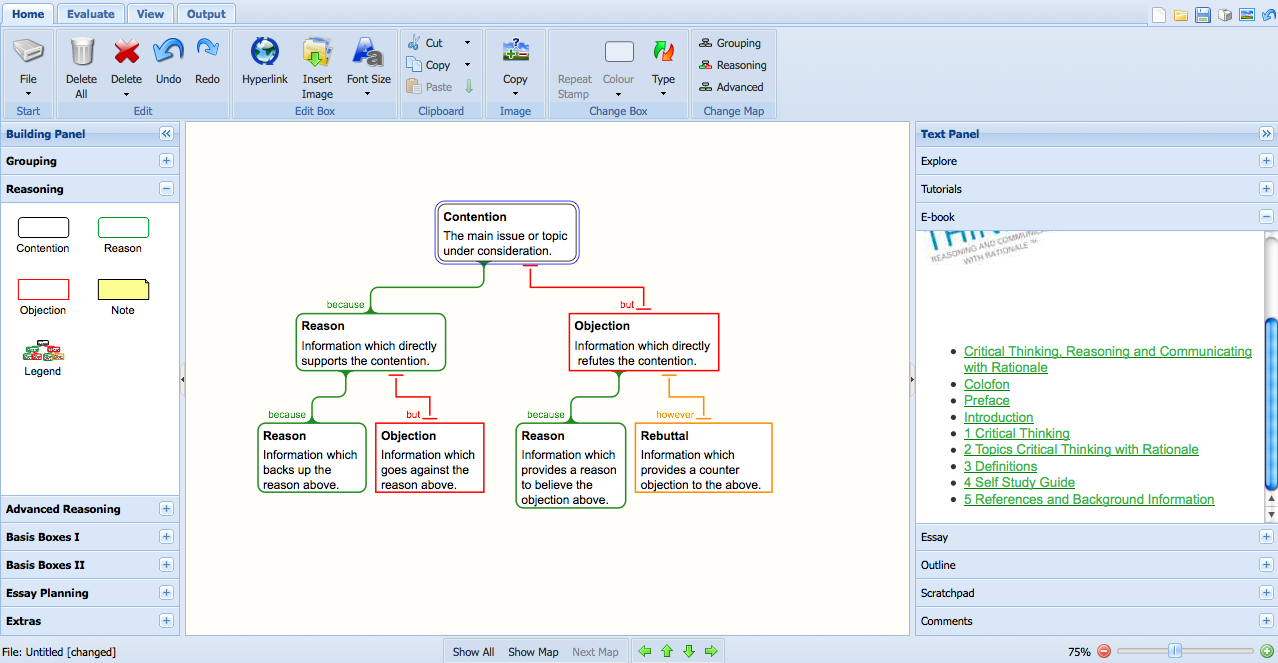
A screen shot of Rationale Online

A screen shot of Rationale Online, click for a larger view.

It’s no secret to regular readers here that I’m a big fan of argument mapping. I’ve written about it several times and it’s come to be a very important component of my teaching. That’s why I’m happy to have added Rationale Online, a web-based version of the Rationale software package, to the RAIL Resources page.  Beyond merely listing it there, though, I thought I’d put up a short post about it as I think it really does represent a positive step in the evolution of argument diagramming software for the classroom.

The diagramming system used in Rationale Online is a descendant of that pioneered by Tim van Gelder (some will remember Reason!Able), wherein one can diagram both arguments and various sorts of rebuttals, with or without incorporating various sorts of argument schemes from a number of different models. (more…)

Read Full Post »

The Argumentation Community Group of the W3C seeks to facilitate and to promote the use of the Web for all forms of argumentation. The group will discuss and design both argumentation representation formats and systems. The group will discuss both argumentation theory and technical discussion topics. The group is working on a set of current projects, requisite technologies, and has upcoming projects planned, formats and ontologies.

This is a call for participation; individuals interested in the aforementioned topics or presenting new topics for discussion are welcomed to participate and to contribute. The group’s mailing list is available at: http://lists.w3.org/Archives/Public/public-argumentation/.

For more information, please contact the group’s chair Adam Sobieski.

http://www.w3.org/community/argumentation/

Read Full Post »

Applications are invited for a PhD studentship in argumentation for
dispute mediation at the University of Dundee, funded by The Leverhulme
Trust.

The studentship forms part of a project which aims to develop a
theoretical foundation to underpin practical tools for
argument-supported dispute mediation. The successful applicant will have
the freedom to explore an area that is relevant to both the project and
their own research interests including, but not limited to:
philosophical and/or computational models of dialogue and argument;
mediation theory and practice; computational linguistics. The
studentship will be held in the Argumentation Research Group in the
School of Computing at the University of Dundee. (more…)

Read Full Post »

Call for Papers

The Second International Workshop on Theory and Applications of Formal Argumentation (TAFA 2013) will be co-located with IJCAI 2013 in Beijing, and builds on the success of TAFA 2011 (co-located with IJCAI 2011). The workshop is inspired by the recent rapid growth of interest in formal models of argumentation and their application in diverse sub-fields and domains of application of Artificial Intelligence. TAFA 2013 aims to further foster uptake of argumentation as a viable AI paradigm with wide ranging application by providing a forum for further development of existing ideas and for the initiation of new and innovative collaborations.

TAFA 2013 therefore encourages submission of papers on formal theoretical models of argumentation and their application in (sub-fields of) AI, and on the evaluation of models of argumentation, both theoretical (in terms of formal properties) and practical (in concretely developed applications). We particularly encourage work on theories and applications developed through inter-disciplinary collaborations. The workshop will also include a demonstration session. (more…)

Read Full Post »

First CFP: Argumentation Technologies@CLIMA XIV

First Call for Papers

Special Session on Argumentation Technologies

CLIMA XIV – 14th International Workshop on Computational Logic in Multi-Agent Systems

http://centria.di.fct.unl.pt/events/climaXIV/

Corunna, Spain, September 16-17, 2013.

Co-located with LPNMR’13.

Submission deadline: June 10th (abstracts June 6th).

Proceedings: LNCS/LNAI volume (available at the workshop).

JLC Special Issue: Selected extended papers will be published in a
Special Issue of the Journal of Logic and Computation.

++++++++++++++++++++++++++++++++++++++++++++++++++++

Argumentation is an important and exciting topic in Artificial Intelligence, where uses of argumentation have increased in recent years, throughout a variety of subdisciplines. Research activities range from theory to applications. The CLIMA XIV Special Session on Argumentation Technologies is intended to be a forum to discuss concepts, theories, methodologies, and applications of computational models of argumentation.

We invite submissions related to (but not limited to) one or more of the following topics: (more…)

Read Full Post »

The Amsterdam Workshop on Truth is organised by the Institute for Logic, Language, and Computation of the University of Amsterdam.

The workshop will take place from Wednesday the 13th to Friday the 15th of March 2013.


The workshop is intended to serve as a meeting point for researchers working on the philosophy of truth in order to discuss latest results and work in progress.
It will address a wide range of truth-related topics and it is open to more formal or less formal approaches.


The following speakers have confirmed participation:

Stefan Wintein,  Philip Welch,  Albert Visser,  Giulia Terzian,  Johannes Stern, Jönne Speck,  Sonja Smets,  Georg Schiemer,  Robert van Rooij,  Carlo Nicolai, Iris Loeb, Øystein Linnebo,  Graham Leigh,  Jeffrey Kettland,  Leon Horsten,  Volker Halbach, Nina Gierasimczuk,  Martin Fischer,  Theodora Achourioti.

 
Workshop venues (map):

Wednesday 13 March, Thursday 14 March: VOC-zall, Bushuis
Friday 15 March: Oudemanhuispoort A0.08

The workshop will start on Wednesday at 12:00 and end on Friday at 15:00.


Attendance is free of charge, however, registration is required.

The deadline for registering is March the 3rd.


More information may be found at the workshop website: http://www.illc.uva.nl/truth/truth13/

Read Full Post »

Two new lectureship openings for folks with competence in computational approaches to argumentation (broadly construed) have been posted at ARG:Dundee.  They are here and here.  Good luck!

Read Full Post »

Call for Papers: JURIX 2012

http://conference.jurix.nl/2012/cfp.html

The 25th International Conference on Legal Knowledge and Information Systems
University of Amsterdam, The Netherlands, 17-19th December 2012

Celebrating 25 years of supporting and enhancing cutting edge research in the interface between law and computer technology, the 2012 JURIX  conference will return to its roots in Amsterdam. We invite submission of original papers on the advanced management of legal information and knowledge, covering foundations, methods, tools, systems and applications for the following (non-exhaustive) list of topics: (more…)

Read Full Post »

RAIL is pleased to recommend the Special Issue of Studies in Logic, Grammar and Rhetoric on Argument and Computation.

If, for some reason, you’re not yet paying attention to the things that are happening in the computation-based wing of argumentation theory, let me ever-so-humbly suggest that you should be. The excellent work being done in this area integrates not only key insights from mainstream contemporary argumentation theory but key insights from the ever-developing field of non-monotonic logic too.  Well and truly gone are the days when, as applied to logic, ‘formal’ meant ‘classical’.  This is truly exciting stuff.  Those with no background in the overlap between argumentation and computation may wish to begin with Chris Reed and Marcin Kosowy’s excellent introduction.  Following that, I would recommend Doug Walton’s article, “How to Refute an Argument in Artificial Intelligence” and Marcin Lewinsky’s article too as being particularly friendly to those whose background is heavier in argumentation and/or dialectics (per the Walton-Krabbe model) than in computation as next steps.

This issue is special in that it shows the relevance of computational approaches to nearly every branch of argumentation theory. To look at what some would consider extremes, for example, formal logic is represented in Kazimierz Trzęsicki’s excellent treatment of the problem of argument classification, but so is rhetoric in the article by Katarzyna Budzyńska and Magdalena Kacprzak, that represents the latest extension of their work at the time of this writing.

It is timely too. For those who have an interest in the way that argumentation is carried out through the medium of the internet this issue will be very useful indeed. The aforementioned article by Lewinsky covers this ground as does the article by Karolina Stefanowicz.  Those interested in contemporary pragma-dialetctics will also find much to pique their interest here, especially the article by the team of Jacky Visser, Floris Bex, Chris Reed and Bart Garssen.

Though of course the computational wing of argumentation theory is established and thriving in departments all over the world, I think this issue of Studies in Logic, Grammar and Rhetoric also shows the variety of good things that are happening in what is becoming the vibrant argumentation theory community of Warsaw. We should all be paying attention.

Read Full Post »

« Newer Posts - Older Posts »