As the title suggests, it’s a wiki for PhD programs in philosophical logic. Nice work here! Tip of the hat to Richard Zach’s blog for posting this, else I might have missed it!
Archive for the ‘Announcements’ Category
New Book on Kant and Rhetoric
Posted in Announcements, Rhetoric, tagged Kant, philosophy and rhetoric, RSA on November 17, 2014| Leave a Comment »
Scott Stroud has a new book out on Kant and rhetoric. The RSA’s announcement about the volume can be found here: New Book on Kant and Rhetoric | The Blogora.
OSSA Proceedings Digital Archive
Posted in Announcements, Argumentation, Connections, Informal Logic, tagged argumentation conferences, argumentation resources, ISSA, OSSA on November 16, 2014| 1 Comment »

Just in case you’ve not yet heard about this, the folks in Windsor have done us all a great service. The proceedings of all OSSA conferences from the very first to the most recent are now available online at the OSSA Conference Archive. Papers and commentaries are available for viewing and download. Search options are up-to-date too. For those of us who want to cite these papers in our work, this is an indispensable and easy-to-use resource that compares favorably with the ISSA Conference Archive maintained by Rozenberg Quarterly. Both are laudable additions to the online resources available for argumentation researchers.
The Winter 2014 Issue of Cogency is Now Available
Posted in Announcements, Argumentation, Discussion, Rhetoric on November 14, 2014| Leave a Comment »
 The latest issue of the journal Cogency is now available! Most articles are open access pdf downloads. Do check it out!
New Journal: Eris: An International Journal of Argumentation and Debate
Posted in Announcements, Argumentation, CFP, Connections, Debate, Discussion, Rhetoric, tagged argumentation theory and practice, epistemology, Eris on October 22, 2014| Leave a Comment »
From the Journal homepage:
In Greek mythology, Eris is the goddess of discord, strife, and quarrel. Aesop warned that Eris should be left undisturbed since combating Eris could cause it to intensify. However, Hesiod recognized Eris’s second nature as a force of progress and improvement, the noble competition. Argumentation and debate can regulate Eris and prioritize its second positive nature, sometimes leading to the solution or dissolution of the dispute.
The purpose of Eris is to refine and reflect on theory and practice of argumentation and debate. It seeks to attract and promote theoretical, empirical, and educational contributions on argumentation and debate from several perspectives (philosophical, rhetorical, educational, psychological, among others) with a focus on both their function to regulate conflicts and disagreements and their epistemic function.
Therefore, we invite you to submit paper proposals for the next issues of Eris. Italian, English, French and Spanish papers will be accepted for peer review.
For paper guidelines, please check the website: Eris.
Post-Doc Position and PhD Studentships at Dundee
Posted in Argumentation, Computation, Job Openings, tagged ArgLab, PhD positions in argumentation, post doc positions in argumentation on September 6, 2014| Leave a Comment »
Applications are invited for two positions in Dundee: a postdoctoral research assistant for the TSB- & EPSRC-funded project “Argument Analytics” (starting from Nov 2014); and for a PhD student for the EPSRC DTG-funded project “Recognizing Trust in Natural Language” (starting from Dec 2014). (more…)
What Happened to RAIL?
Posted in About RAIL, Announcements on September 6, 2014| Leave a Comment »
It’s true, not much has happened here this summer. What gives?
Well, we had a little trouble. We had some illnesses, shifting burdens at work that included some heavy, important, and unforeseen tasks, and to top it all off, a flood that put most of the the RAIL home office out on the curb for the trash man. It was an eventful couple of months.
Things are looking up though. I’ve a place I can work set up again, and I’ll be clearing the backlog of announcements and ArgEvents calendar updates over the next couple of days and, with any luck, we’ll be back up and running as usual thereafter. In the meantime, please accept my apologies for late and delayed postings!
Happy Arguing!
SP
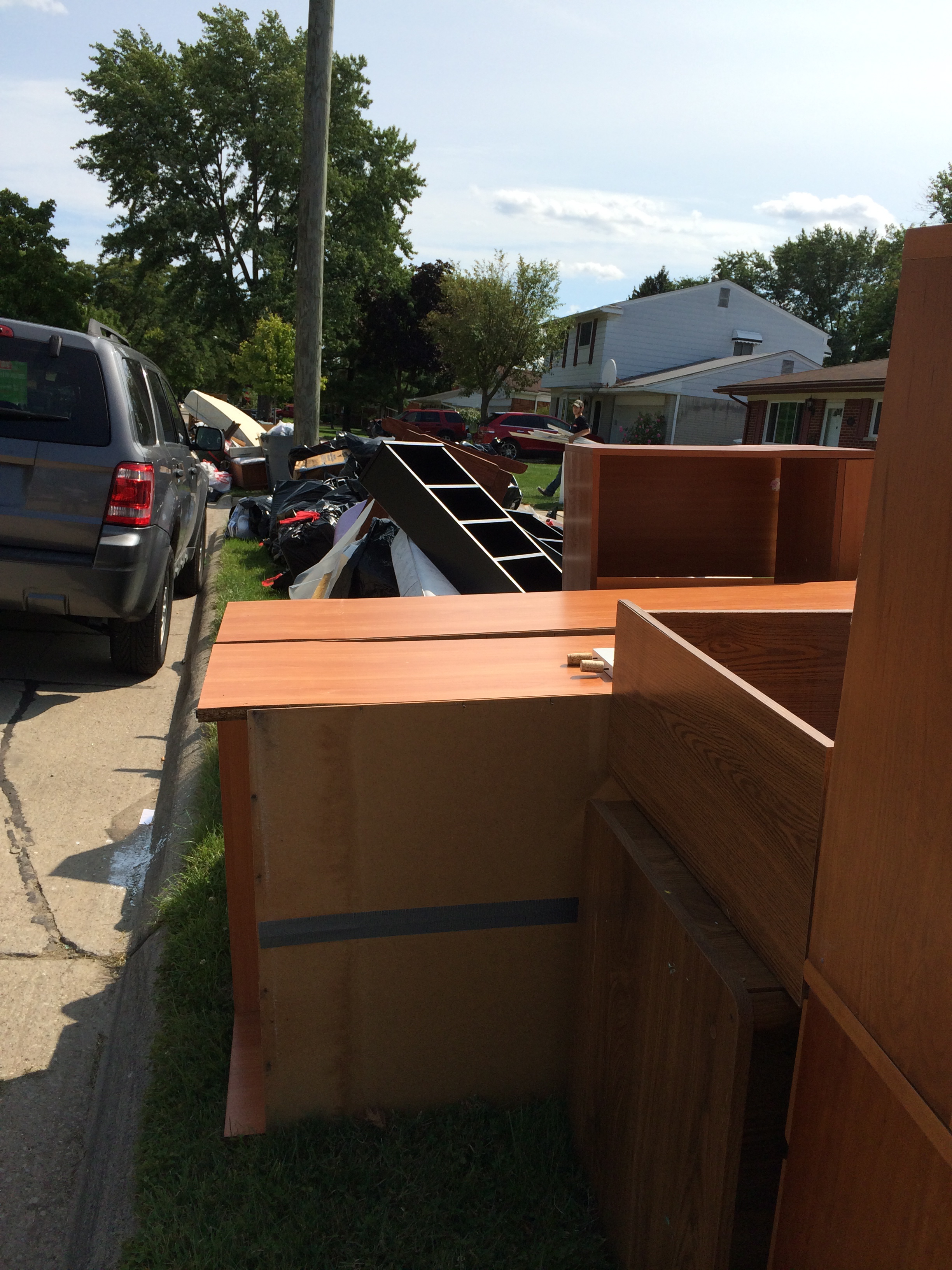
My notes are in here somewhere…or are they?
CFP: Workshop on Argument Mining
Posted in Argumentation, CFP, Computation, Connections, Workshops, tagged argument mining, computational linguistics on June 16, 2014| Leave a Comment »
Workshop on Argument Mining: Perspectives from Information Extraction, Information Retrieval and Computational Linguistics
9-10 July 2014, Dundee, Scotland
http://www.arg.dundee.ac.uk/swam2014
SECOND CALL FOR PAPERS AND PARTICIPATION
Submissions of position statement are invited for the SICSA Workshop on Argument Mining to be held in Dundee, Scotland.
Argument mining exploits the techniques and methods of natural language processing, or more specifically – text and opinion mining, for semi-automatic and automatic recognition and extraction of structured argument data from unstructured natural language texts. Lying at the intersection of sentiment analysis and computational models of argument, it is attracting increasing attention with an ACL workshop on the topic in Baltimore (http://www.uncg.edu/cmp/ArgMining2014/) and a meeting dedicated to the topic in Warsaw (http://argdiap.pl/argdiap2014).
Summer School on Argumentation: Computational and Linguistic Perspectives
Posted in Argumentation, Computation, Connections, Linguistics, Summer School, tagged AISB, COMMA 2014, computation and argumentation on June 16, 2014| 2 Comments »
FIRST CALL FOR PARTICIPATION
Summer School on Argumentation: Computational and Linguistic Perspectives
Thu Sept 4th – Mon Sept 8th 2014, Dundee, Scotland http://ssa2014.arg.dundee.ac.uk/
The Summer School aims to provide attendees with a solid foundation in computational and linguistic aspects of argumentation and the emerging connections between the two. Furthermore, attendees will gain experience in using various tools for argument analysis and processing.
The School is being held in the days before the COMMA 2014 conference in Pitlochry (http://comma2014.arg.dundee.ac.uk) and will include tutorials from the conference’s invited speakers, as well as other leading academics in computational approaches to argumentation and linguistics.
Search
-
Join 149 other subscribers
Translate
Archives
Categories
- About RAIL (7)
- Announcements (57)
- Argumentation (123)
- CFP (191)
- cognitive science (3)
- Communication (29)
- Computation (55)
- Connections (158)
- Contests (1)
- Contests & Competitions (4)
- Critical Thinking (43)
- dark arts (1)
- Debate (3)
- Discourse Analysis (19)
- Discussion (86)
- Fallacies (20)
- Feedback & Suggestions (1)
- Graduate Studies (3)
- Grant Opportunities (1)
- Grants (1)
- Guest Posts (1)
- Humor (3)
- In memoriam (1)
- Informal Logic (48)
- Job Openings (20)
- Linguistics (15)
- Logic (29)
- News (22)
- Pragma-dialectics (16)
- Rationality (32)
- Research Projects (6)
- Rhetoric (62)
- Seminar (2)
- Seminar/Workshop/Program Announcements (22)
- Studentships (1)
- Summer School (8)
- Symposium (4)
- Teaching (30)
- Uncategorized (8)
- Workshops (12)
Meta

 RAIL
RAIL 