Feeds:
Posts
Comments

Archive for October, 2011

For those who may not be aware of it yet, The Reasoner is wonderful, interdisciplinary, monthly publication devoted to matters that fall largely within the sphere of formal logic and research on reasoning.  Because the focus is so often on formal methods this may not seem, at first, to be the kind of thing that most argumentation theorists naturally would be inclined to look at, but I find it often contains vignettes, short articles, and interviews that ofter serious food for thought to those with interests in informal logic, argumentation, and critical thinking.

A case in point is the most recent issue (vol. 5 no. 11), which contains a fascinating interview with mathematical logician Wilfrid Hodges and a sharp little essay attacking the distinction between critical and creative thinking by A. Minh Nguyen. (Readers of this blog may recall similar ruminations offered in this post from April of 2010).  To whet your appetite, here’s a quote from the Hodges interview:

I have no patience at all with the view of Kant, followed by Frege and some modern writers, that logic studies how we ought to think and psychology studies how we do think. A logician can tell you that if you reason by rule X, then you will sometimes find yourself deducing false conclusions from true premises. It does follow that if you want never to deduce false conclusions from true premises, you ought not to use rule X. So for example you ought not to use rule X in a research paper in pure mathematics. But in real life, where time and memory are often limited and premises are often dubious in one way or another, rule X might be for practical purposes exactly what you need. One of the major achievements of logic of the last fifty years is to start taking seriously the constraints under which we reason, and the different aims that we can have in our reasoning. This expansion of logic gives many openings for collaboration between logicians and cognitivists [i.e. cognitive scientists].

The interview moves from considerations like this one to a discussion of the relationship between logic and cognitive science, and includes an interesting discussion of the logic of the medieval Arab philosopher Ibn Sina.

The Reasoner is an open access publication. Its present and past issues as well are all downloadable in .pdf format free of charge.
Read Full Post »

The journal THEORIA has just published its 72nd issue with a symposium on Lilian Bermejo-Luque’s, Giving Reasons (Springer, 2011. Argumentation Series). The discussants are John Biro, Harvey Siegel, James B. Freeman, David Hitchcock, Robert C. Pinto and Luis Vega.

In Giving Reasons, Bermejo-Luque attempts to set out and defend an original approach to argumentation theory that hinges on what she calls “argumentation as a second order speech-act complex”.  The discussion that emerges between Bermejo-Luque and her distinguished panel of respondents about this approach to argumentation theory  is an interesting one.  Click here to view the journal page, from which all articles can be accessed free of charge: http://www.ehu.es/ojs/index.php/THEORIA/issue/current.

Read Full Post »

Call for Papers

Rhetoric in Society 4

“Contemporary Rhetorical Citizenship:

Purposes, Practices, and Perspectives”

Department of Media, Cognition, and Communication

Section of Rhetoric

University of Copenhagen

January 15-18, 2013

This is the first bulletin of the fourth biennial Rhetoric in Society Conference to be held January 15-18, 2013 at the University of Copenhagen, Denmark.

With this bulletin, we want to invite you to do two things: mark your calendars and start thinking about how you might contribute to the conference with your scholarship.

Below, we introduce the theme of the conference and provide basic information about the various presentation formats.

Within a few weeks, we will contact you again with more information about the conference program, key-note speakers, and how to submit an abstract.

In the planning of the conference we wish to promote discussion among conference attendees. One way is to set time aside for discussion in all meetings, another is to allow for regular breaks, and a third way is to arrange social gatherings suitable to networking and amicable conversation. We hope you will come and be part of the discussion!

Theme

The theme for this fourth conference on Rhetoric in Society is “Contemporary Rhetorical Citizenship: Purposes, Practices, and Perspectives”.

With the concept of rhetorical citizenship we want to draw critical attention to the ways in which being a citizen in a modern democratic state is in many respects a discursive phenomenon. Citizenship is not just a condition such as holding a passport, it is not just behavior such as voting; citizenship also has a communicative aspect: Some perform citizenship when they watch a political debate on TV or discuss a program about homeless people with their colleagues over lunch – or when, one day, they don’t duck behind the fence but engage their cranky neighbor in conversation about her views on city street lighting. Others enact citizenship when they engage in political debates on Facebook or Twitter or join their friends in coming up with the most poignant wording for a protest sign the day before a street demonstration. And for others still, “rhetorical citizenship” is a distant ideal far from the realities of their everyday life; because the legal citizenship, literacy, and media access that such a conception of citizenship often presupposes aren’t within their reach, their experience with rhetorical citizenship is one of exclusion.

Rhetoric, with its double character as academic discipline and practice, stands in a unique position to engage the linguistic and discursive aspects of collective civic engagement. Drawing on and in collaboration with neighboring fields of inquiry such as political science, discourse studies, linguistics, media studies, informal logic, practical philosophy and social anthropology, scholars of rhetoric are able to study actual communicative behavior as it circulates in various fora and spheres – from face to face encounters to mediated discourse. With our diverse theoretical and methodological backgrounds we hold many keys to pressing concerns such as the alleged polarization and coarsening of the ‘tone’ in public debate, the turning away from political engagement toward smaller spheres of interest, and the general difficulty in making politics work constructively in many parts of the world, not least the EU.

We invite attendees – scholars, teachers, students, and citizens across a range of disciplinary traditions – to extend our knowledge of the social roles of rhetoric through theoretical and critical study, and to consider our roles as public intellectuals: how are we to name, describe, criticize, analyze, and, indeed, undertake or teach rhetorical action on matters of communal concern whether locally, nationally, or internationally?

(more…)

Read Full Post »

An ANNIVERSARY CONFERENCE to celebrate
25 years of the Discourse and Rhetoric Group
10 years of the Culture and Media Analysis Research Group
March 21st-23rd 2012

Call for individual papers
Please submit your Abstract via Loughborough University’s Conference Administration page: http://www-staff.lboro.ac.uk/~ssca1/DCconf2012/DC2012home.html

We encourage submissions that engage with empirical and theoretical topics in communication studies, discourse analysis, conversation analysis, media studies, social interaction, or cultural studies. Preference will be given to papers that address in original ways the promises and challenges or research in any of these (inter)disciplinary areas.

Abstracts should be up to 350 words in length and written in English. Only one abstract as single / first author will be accepted from any one individual.

Deadline for Abstracts: 1st November, 2011

Looking forward to meeting you in Loughborough!
***
Dr. Sabina Mihelj
Senior Lecturer in Communication and Media Studies
BSc Communication and Media Studies Programme Director
Department of Social Sciences
Brockington Building
Loughborough University
LE11 3TU Loughborough
UK
Url: http://www.lboro.ac.uk/departments/ss/staff/mihelj.html

Click link for more information…
http://diskursanalyse.net/wiki.php?wiki=en%3A%3AEvents&id=538

Read Full Post »

Miss OSSA? Here's your chance to catch up!


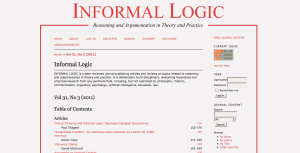
RAIL is pleased to announce the appearance of a new issue of Informal Logic.  This issue features the keynote papers and the paper that won the J. Anthony Blair prize for best student paper.  Those who followed my postings here or on Twitter during the conference will recall my mentions of Karen Tracy’s fascinating keynote address. Here’s a chance to read the paper itself. While you’re at it I also highly recommend Moldovan and Smith’s Blair Prize paper “Arguments as Abstract Objects”.  Together with Geoff Goddu’s AILACT Prize paper (highlighted in a post of its own here on RAIL not too long ago), I’d say Moldovan and Smith’s paper marks the distinct emergence (some would say re-emergence) of an interesting metaphysical sub-field in informal logic and argumentation theory. It will be interesting to see how others respond to the arguments marshaled in these two papers. At any rate, there’s no denying that the gauntlet has been thrown down!  Happy reading. 🙂

Read Full Post »